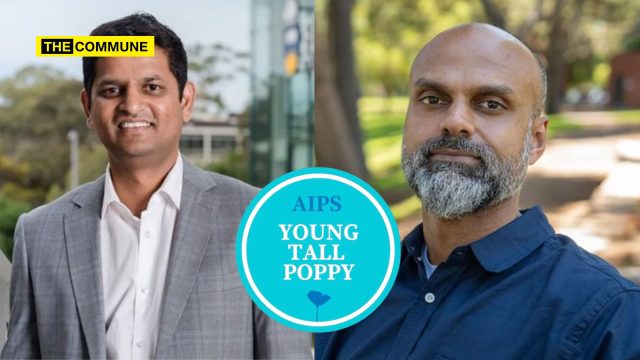
Two South Australian researchers of Indian origin have been recognised with the prestigious 2025 Young Tall Poppy Science Awards for their work in advancing workplace inclusion and promoting global health.
Dr Ashokkumar Manoharan, Senior Lecturer in Strategic Management at Flinders University and researcher at the Centre for Social Impact, received the award for his research on diversity, equity, and inclusion in the workforce. His studies focus particularly on migrant workers and people with intellectual disabilities in the hospitality sector.
Born in Madurai, India, Dr Manoharan trained as a chef before completing an MBA, an M.Sc. in Psychology, and later a doctorate in Management at the University of South Australia. His research, conducted with international collaborators, aims to provide employers with practical strategies to build more inclusive and accessible workplaces.
Dr Ben Singh, Postdoctoral Research Fellow at the University of South Australia’s ARENA research centre, was also honoured. With a background in exercise physiology, Dr Singh’s work focuses on the role of physical activity in cancer care and digital health. His research has been published internationally, presented at global conferences, and shared through mainstream media.
Dr Singh collaborates with healthcare organisations and NGOs to integrate exercise into oncology care, aiming to improve the health and wellbeing of cancer patients worldwide.
The awards will be formally presented at a ceremony at the South Australian Museum on Friday. The Australian Institute of Policy and Science (AIPS), which organises the Young Tall Poppy Science Awards, said the recognition highlights both research excellence and the public engagement of science.
Our 2024 YTP campaign received an enormous 328 nominations, & 73 Young Tall Poppies were awarded. With disciplines from medical research & environmental science to engineering & technology.
What a year!👏
Thank you to our sponsors, w/out them, we could not celebrate AU science pic.twitter.com/BJ4Q7f8pJD— Australian Institute of Policy & Science (@AIPS_science) November 1, 2024
(With inputs from Australia Today)
Subscribe to our channels on Telegram, WhatsApp, and Instagram and get the best stories of the day delivered to you personally.