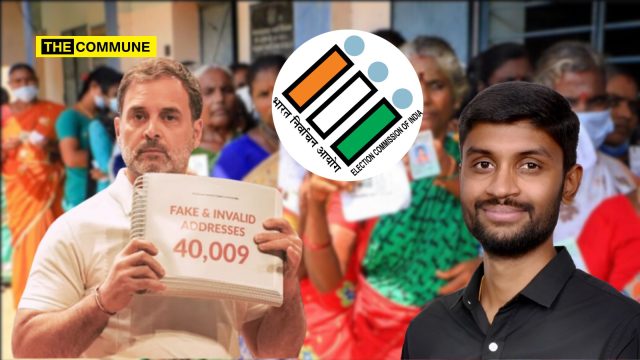
The ongoing pattern of overt support for the Congress by the left-leaning media ecosystem continues, with so called ‘neural’ journalists like Arvind Gunasekar once again distorting facts to suit their narrative.
On 10 August 2025, Gunasekar via his official X account stated, “ECI tells SC that they cannot provide the names of 65 lakh people who have been excluded from the draft electoral rolls in Bihar, nor “the reasons for non-inclusion of anyone in the draft electoral rolls for any reasons”. After refusing to share digital, machine readable format of the voter list, now ECI refuses to share the list of excluded names too.”
ECI tells SC that they cannot provide the names of 65 lakh people who have been excluded from the draft electoral rolls in Bihar, nor “the reasons for non-inclusion of anyone in the draft electoral rolls for any reasons”.
After refusing to share digital, machine readable format… pic.twitter.com/MuuHGLmelU
— Arvind Gunasekar (@arvindgunasekar) August 10, 2025
He carefully framed this as a continuation of the Election Commission’s (ECI) supposed reluctance to ensure transparency linking it to the earlier decision not to provide machine-readable voter lists. However, this portrayal is a textbook case of selective quoting and intentional omission of context.
What the ECI Actually Told the Supreme Court
The real facts paint a very different picture. In its official statement submitted to the Supreme Court regarding the Summary Intensive Revision (SIR) in Bihar, the ECI clearly stated that booth-level draft electoral rolls were already shared with all political parties and a list of individuals whose enumeration forms were not received was also provided at the booth level to political parties. Further it stated any individual excluded from the draft rolls can submit Form 6 with a declaration to be included during the claims and objections period (1 August to 1 September 2025).
Crucially, the ECI explained that existing electoral laws unchanged since before 2014 do not require the Commission to publish or maintain a separate list of excluded voters or to specify reasons for exclusion. The framework assumes that names not appearing in the draft rolls are due to common causes such as death, change of residence, or failure to submit an enumeration form. The corrective process is explicitly built into the system via Form 6 and Annexure-D.
The ECI’s position is fully aligned with the legal structure and operational guidelines “Neither the law nor guidelines provide for the creation or publication of any such separate list of excluded individuals or the reasons for their non-inclusion.”
Moreover, the Commission emphasized that no preliminary inquiry is made before listing names in the draft rolls. Every enumeration form received is included without reservation. Therefore, it’s procedurally unnecessary and legally unsupported to publish exclusion reasons or names. Anyone missing from the draft roll can file a claim, which itself implies that the individual is not deceased, relocated, or untraceable.
Furthermore, it is the responsibility of both political parties and ordinary citizens to actively monitor the voter roll preparation process and raise any concerns or discrepancies before the final list is published. However, instead of fulfilling this duty, the Congress chose to shift blame onto the Election Commission, demanding that it maintain data it is neither legally obligated nor required to preserve.
Despite all this, Gunasekar chose to highlight only the narrow portion of the ECI’s submission that suited his narrative, ignoring the broader context that explained why names were not listed and what remedy was available.
Subscribe to our channels on Telegram, WhatsApp, and Instagram and get the best stories of the day delivered to you personally.