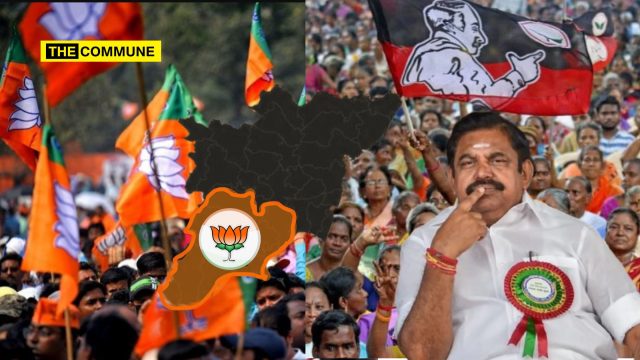
AIADMK General Secretary and Leader of the Opposition Edappadi K. Palaniswami (EPS) recently stirred debate with a remark during his speech, “Mr. Stalin, we are not fools. AIADMK will win with a majority and form the government independently. We will decide if we want an alliance or not.“ Though EPS later clarified that the alliance is intact 100% and will continue to be so, the comment has nonetheless created ripples potentially weakening the broader objective of unseating the DMK in the 2026 Assembly elections.
Edappadi K. Palaniswami of the AIADMK appears to be overlooking some crucial political realities of the recent past. Under his leadership, the party no longer has the influential figures who once played a key role in unifying the AIADMK cadres at the ground level during the 2021 elections. Leaders like O. Panneerselvam, T.T.V. Dhinakaran, and V.K. Sasikala, who, under Jayalalithaa’s guidance, helped maintain the party’s stronghold in the southern regions of Tamil Nadu.
The results of the 2024 Lok Sabha elections made it clear that the BJP has made significant strides in the southern belt, in many cases surpassing the AIADMK and relegating it to third place. In this context, for Palaniswami to assume that the large crowds attending his rallies are a reflection of his personal popularity or the continued appeal of MGR and Jayalalithaa’s legacy is a misreading of the ground reality. Mistaking this enthusiasm as a signal of guaranteed support could be a strategic misstep, especially when the party’s vote base is clearly shifting.
A Fragmented Past And The Missing Pillars
Since the 2021 Assembly elections, AIADMK has not been the unified force it once was under J. Jayalalithaa. Key leaders like O. Panneerselvam, T.T.V. Dhinakaran, and V.K. Sasikala once instrumental in holding the southern vote base together are now either sidelined or in opposition to the EPS-led faction. The absence of these Thevar community heavyweights has severely weakened AIADMK’s hold in the south.
In the 2024 Lok Sabha polls, the consequences of this fragmentation became evident. The BJP, allied with OPS and Dhinakaran, made significant inroads in southern districts, often pushing the AIADMK to a distant third position in constituencies such as Tirunelveli, Theni, Kanyakumari, and Madurai.
EPS’s interpretation of the large public turnout at his rallies as a direct endorsement of his leadership or the AIADMK’s legacy (through MGR and Jayalalithaa) is misleading. The political landscape has changed, and crowd size does not necessarily reflect electoral strength especially when party structure, leadership appeal, and social coalition have become fractured.
AIADMK’s Shrinking Footprint Down South
The erosion of support in the south is not accidental it’s structural. The AIADMK, under EPS, is increasingly perceived as a Gounder-dominated party, alienating the Thevar community that once formed the party’s southern backbone. EPS’s refusal to reconcile with leaders like OPS and Dhinakaran despite internal calls from veterans such as K.A. Sengottaiyan, Natham Viswanathan, SP Velumani, and C.V. Shanmugam has only deepened the divide.
On 7 July 2024, six senior leaders reportedly met with EPS in Salem, urging him to reunify the party and reconcile with estranged factions. However, EPS firmly rejected any merger or reconciliation, choosing instead to chart a solo course. This decision, critics argue, risks ceding further ground to rivals in southern Tamil Nadu. This naturally positions the AIADMK to rely on an alliance with the BJP whose influence in the south is steadily growing along with the supportive alliance of O. Panneerselvam and T.T.V. Dhinakaran, to regain its footing and remain competitive in the southern regions of Tamil Nadu.
BJP’s Strategic Rise In The South
The 2024 general elections proved to be a wake-up call for the AIADMK. While the DMK-led alliance swept all 39 Lok Sabha seats in Tamil Nadu and Puducherry, it was the BJP not the AIADMK that emerged as the runner-up in several southern constituencies. The saffron party’s ability to consolidate anti-DMK votes thanks to its alliance with OPS, Dhinakaran’s AMMK, and the PMK allowed it to outperform the AIADMK in at least a dozen southern and central constituencies.
The BJP secured 11.24% of the vote share on its own, and the NDA collectively pulled in 18.27%, pushing the AIADMK to third and even fourth position in districts where it once dominated. The AIADMK’s overall vote share dropped from 30.56% in 2019 to 20.46% in 2024, and it lost deposits in seven key constituencies, including South Chennai, Kanyakumari, Puducherry, and Thoothukudi.
This vote drift has made one fact abundantly clear, in the south, the BJP is fast becoming the primary opposition force, while the AIADMK continues to bleed support.
Anti-Incumbency Against DMK: A Wasted Opportunity?
Public dissatisfaction with the ruling DMK government has been steadily growing. The anti-incumbency mood presents a ripe opportunity for the opposition but only if it unites. If the anti-DMK vote continues to splinter among AIADMK, BJP, NTK, and emerging players like Vijay’s Tamilaga Vettri Kazhagam (TVK), the ruling party could retain power despite the public mood.
EPS’s comments that seemed to downplay or distance the BJP his party’s strongest ally in the south risk diluting the alliance’s collective impact. Many within the AIADMK see the alliance with the BJP as critical, not just tactically but strategically, to prevent vote division and challenge the DMK’s dominance.
Even prominent AIADMK figures like former Chennai Mayor Saidai Duraisamy have called for a return to MGR-style politics forming pragmatic alliances to defeat a common political opponent. Given the current scenario, that common enemy is clearly the DMK.
The Path Ahead
EPS finds himself at a critical juncture. His refusal to engage with former allies and his ambiguous remarks about AIADMK’s need for an alliance could jeopardize the party’s chances in 2026. While projecting strength and independence may resonate with party loyalists, the numbers show that without a broader alliance especially with the BJP and southern powerbrokers like OPS and Dhinakaran AIADMK’s chances of regaining power are slim.
The question isn’t whether AIADMK wants the BJP. The question is: can it afford not to?
In southern Tamil Nadu, the reality is stark the AIADMK needs the BJP and its allies far more than the BJP needs them. If EPS fails to recognize this and continues to alienate potential partners, the party risks further decline, ceding its traditional strongholds to both the BJP and the DMK.
Subscribe to our channels on Telegram, WhatsApp, and Instagram and get the best stories of the day delivered to you personally