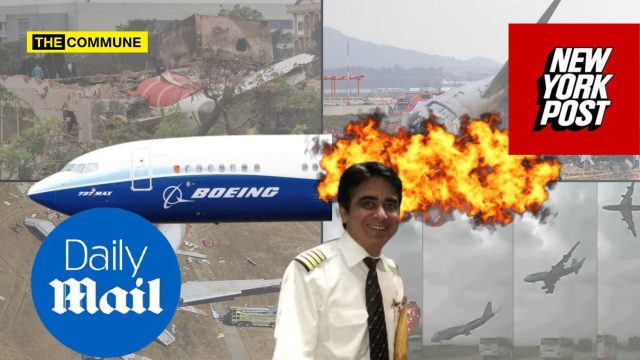
Even as investigations into the tragic Air India Flight 171 crash remain ongoing, sections of the Western media, led by Daily Mail and New York Post, have shamelessly amplified an unverified narrative blaming the pilots, particularly Captain Sumeet Sabharwal, for the Ahmedabad plane crash. Their reporting, riddled with sensationalism and selective leaks, appears designed to deflect blame from Boeing, whose troubled 787 Dreamliner has faced multiple safety concerns in recent years.
The Dubious “Depressed Pilot” Narrative
Days after the Aircraft Accident Investigation Bureau (AAIB) released a preliminary report highlighting the mysterious fuel cutoff switch activation, Western outlets pivoted to speculative character assassination of the deceased pilots.
Daily Mail and New York Post prominently featured unverified claims from unnamed sources that Captain Sabharwal had a history of depression and mental health issues, implying he may have deliberately crashed the plane.
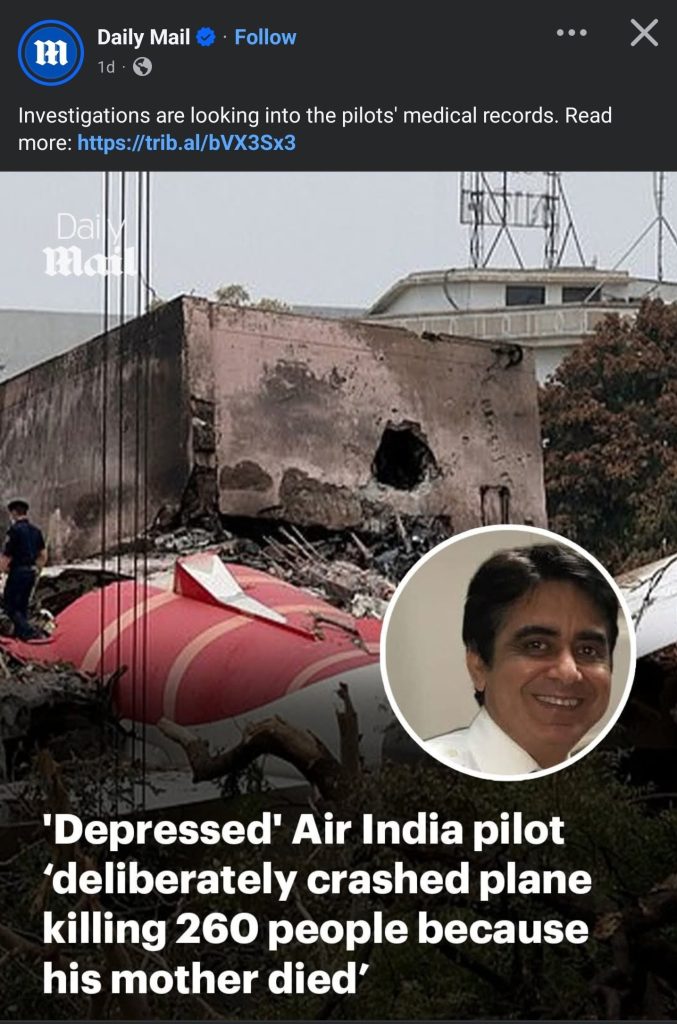
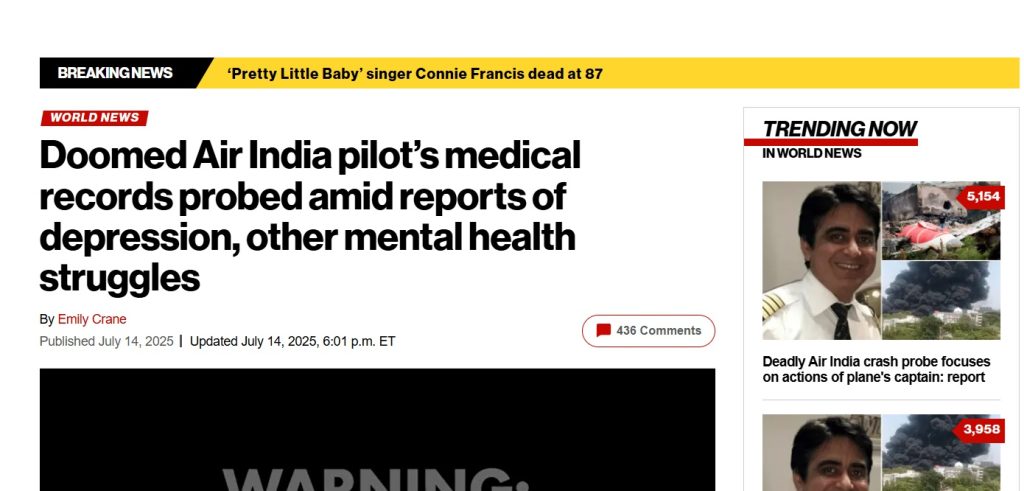
The reports cherry-picked statements from aviation expert Captain Mohan Ranganathan, who speculated about “pilot-induced crash” despite no conclusive evidence.

Both outlets ignored critical context that Sabharwal had been medically cleared by Air India, and his last Class I medical exam found him fully fit to fly.
This irresponsible framing not only disrespects the memory of a decorated pilot with 15,000+ flight hours but also prejudices public opinion before the investigation concludes.
Why the Sudden Focus on Pilot Mental Health?
The timing of these reports raises serious questions:
Boeing’s Mounting Scandals – The 787 Dreamliner has faced multiple whistleblower complaints over manufacturing defects, with FAA investigations still pending. Here is a look at Boeing’s timeline of disaster.
Boeing’s growing problems did not start with Ahmedabad. The company’s track record over the last few years reveals a disturbing pattern:
March 21, 2022 — China Eastern 737-800 Crash: All 132 perished in a catastrophic mid-air incident. The subsequent investigation raised doubts about control surface functionality — a conclusion, Chinese regulators challenged, even as Boeing insisted it was due to pilot error.
January 5, 2024 — Alaska MAX-9 incident: A side panel, a door plug, blew out mid-flight with 177 people on board. The incident forced the FAA to ground all 737 MAX-9 jets. Shortly afterwards, Boeing’s CEO, David Calhoun, announced his resignation.
November 25, 2024 — Swiftair Cargo Crash in Lithuania: An older 737-400 went down, killing 1 and injuring 3. This incident raised additional questions about continued reliance on older models due to delivery delays and poor production schedules with newer jets.
December 29, 2024 — Jeju Air Crash-Landing in South Korea: The 737-800 overran the runway, causing 179 deaths. South Korean authorities opened a criminal investigation in its wake, fueling growing outrage.
June 12, 2025 — Air India 787-8 Crash in Ahmedabad: The most catastrophic incident in this timeline, adding to growing doubts about Boeing’s ability to produce a safe, reliable aircraft.
The FAA twice halted Dreamliner deliveries (2021-2023) over manufacturing defects, but Boeing resumed production without full transparency. In April 2024, the FAA reopened probes into faulty fuselage joins—the same issue suspected in the Ahmedabad crash.
The Whistleblower Crisis: A Pattern of Silencing Dissent And Cover-Ups
The Ahmedabad Dreamliner crash has reignited scrutiny not just of Boeing’s engineering failures, but of its systematic suppression of whistleblowers who tried to warn about these very dangers. The deaths of insiders like John Barnett, the retaliation against Sam Salehpour, and the fake titanium scandal paint a damning picture of a corporation that prioritizes profits over lives.
John Barnett: The Whistleblower Who Died “Mid-Testimony”
A 32-year Boeing veteran and quality manager at Boeing’s North Charleston plant (787 Dreamliner production site). In 2019, he went public with explosive allegations:
- Defective oxygen systems: Up to 25% of 787 Dreamliners had faulty oxygen masks that might fail mid-flight.
- Scrap bin parts: Workers were retrieving rejected parts from trash and installing them on planes to meet deadlines.
- Rushed inspections: Pressure to skip safety checks led to “non-conforming” parts being untraceable.
In March 2024, Barnett was found dead in his truck in Charleston, South Carolina, from a gunshot wound (ruled a suicide by police). He was midway through depositions for a whistleblower lawsuit against Boeing. A note was recovered but the contents were not disclosed and his family called it a “staged scene”. His estate filed a wrongful death case, accusing Boeing of harassment and intimidation.
Why this matters for Ahmedabad is that Barnett’s warnings about 787 oxygen systems and structural defects directly relate to the Ahmedabad crash investigation. His death silenced a key witness who could have exposed systemic quality control failures in Dreamliners.
Sam Salehpour: The Engineer Who Exposed “Jumped-On Fuselages”
His allegations (2024 FAA complaint) include:
- Fuselage gaps: Boeing workers “jumped on misaligned fuselage parts” to force them together, risking mid-air disintegration.
- 1,000+ risky jets: Over 400 Boeing 777s and 1,000 Dreamliners could face premature fatigue failures.
- Retaliation: After reporting 787 defects, he was transferred to the 777 program—where he found similar flaws.
Boeing denied the claims, but FAA reopened Dreamliner probes in April 2024—just 2 months before Ahmedabad crash.
The Fake Titanium Scandal
In June 2024, Boeing admitted counterfeit titanium (with falsified paperwork) was used in some 787/777 jets. This compromised structural integrity, especially under stress. It was reported that the titanium was purchased from a Chinese supplier who sold fake metallurgy certs that Boeing failed to verify.
Uses fake titanium in its aircraft, refuses to fix software bugs, persists with flawed engineering designs and runs loose and fast with safety standards for years. Gets flagged by multiple whistleblowers who then are conveniently found dead. Pays what is effectively blood money… https://t.co/dA06aGWH47
— Surya Kanegaonkar (@suryakane) June 12, 2025
Workers’ Confessions: “We Wouldn’t Fly On The Dreamliner”
A 2024 internal survey at Boeing’s South Carolina plant revealed that 10 out of 15 workers refused to fly on the 787, citing:
- Rushed assembly: “They cut corners to meet quotas.”
- Drug use: Some workers “high on opioids” during shifts.
- Defective parts: “If you flag issues, managers ignore you.”
🚨THROWBACK SHOCKER: Boeing workers once said they WOULDN’T FLY on the 787 Dreamliner pic.twitter.com/JGgl4yHEFy
— Sputnik India (@Sputnik_India) June 12, 2025
CEO’s Falsified Records: Caught On Camera
A 2024 Senate hearing exposed Boeing CEO Dave Calhoun in a lie. There was video evidence of him personally signing off on faulty 787 inspections despite knowing defects. Calhoun resigned (January 2024), but no criminal charges were filed.
Here’s a video from last year of Boeing’s (now ex) CEO being confronted by a US senator for personally falsifying inspection records for the 787 – the same plane that crashed in Ahmedabad today pic.twitter.com/RAk35Hh7a2
— Abhinav Kukreja (@kukreja_abhinav) June 12, 2025
History Of Blaming Pilots (Boeing)
Boeing and its enablers continue to enjoy immunity from the kind of scrutiny that has followed pilots, despite the troubling history of software flaws, mechanical failures, and ignored warnings linked to previous Boeing disasters.
Malaysia Airlines Flight MH370 disappeared on March 8, 2014, while flying from Kuala Lumpur, Malaysia, to Beijing, China. The Boeing 777-200ER, carrying 227 passengers and 12 crew members, lost contact with air traffic control less than an hour after takeoff and vanished from radar. But years later, the pilot suicide theory was mainstreamed and documentaries were made to establish it.
Ethiopian Airlines 737 MAX Crash (2019) – Initial reports focused on pilot training, later proven irrelevant after Boeing admitted software flaws.
Lion Air Crash (2018) – Similar “pilot error” narrative collapsed when MCAS system failures were exposed.
Now, history repeats with Air India 171—another Boeing aircraft, another hasty blame shift.
Instead of letting investigators do their job, Western tabloids have pre-empted the truth with lazy innuendo, deflection, and a cynical defense of corporate power.
Subscribe to our channels on Telegram, WhatsApp, and Instagram and get the best stories of the day delivered to you personally.