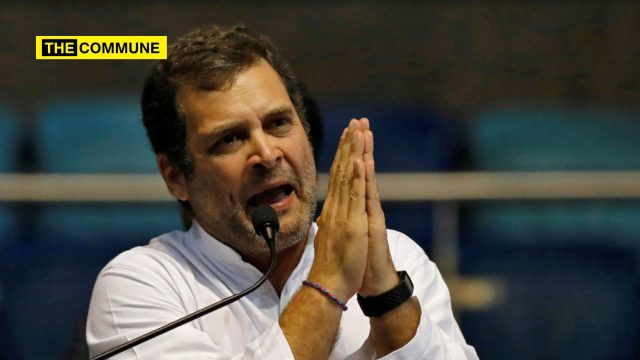
Congress MP and Leader of Opposition in Lok Sabha, Rahul Gandhi, surrendered before the MP/MLA Special Magistrate Court in Lucknow on Tuesday in connection with a criminal defamation case over alleged derogatory remarks made against the Indian Armed Forces during his Bharat Jodo Yatra in December 2022.
Appearing personally after missing five previous hearings, Gandhi presented himself before Additional Chief Judicial Magistrate Alok Verma. The court granted him bail after accepting his surrender and allowing his bail application. He was released upon furnishing two personal bonds of ₹20,000 each, along with two sureties of the same amount.
The court had earlier denied repeated exemption requests and insisted on Gandhi’s personal appearance, especially after the Allahabad High Court in May 2025 rejected his plea to quash the defamation case and the summoning order issued by the lower court.
During Tuesday’s proceedings, the crowded courtroom prompted the police to escort Gandhi directly to the judge’s chamber, where the bail formalities were completed. Gandhi did not issue any public statement or apology before the court regarding the remarks in question.
His legal team, led by Advocate Pranshu Agrawal, maintained that no offence was made out and pleaded for discharge. The complainant’s counsel, however, opposed bail, alleging that Gandhi had insulted the Indian Army and attempted to undermine its morale through his comments.
The complaint, filed by former Border Roads Organisation (BRO) Director Uday Shankar Srivastava, pertains to remarks Gandhi allegedly made on 16 December 2022, in the aftermath of the Tawang clash between Indian and Chinese troops. Gandhi was accused of repeatedly claiming that the Chinese Army was “thrashing” Indian soldiers and that the Indian media was failing to question the government over the incident.
Let’s take a look at the number of times Rahul Gandhi apologised for his loose tongue and surrendered in court.
Surrender Man – Rahul Gandhi
Here are some of the instances where Rahul Gandhi has had to apologize or clarify his statements and surrender in court, for bail, particularly those that have caused outrage and controversy.
#1 National Herald Case
The National Herald case, initiated by BJP leader Subramanian Swamy in 2012, alleged financial irregularities in the acquisition of Associated Journals Ltd (AJL) by Young Indian Ltd (YIL), a company controlled by Congress leaders Sonia and Rahul Gandhi. Swamy claimed YIL, with no commercial operations, was created to acquire AJL’s assets worth over ₹2,000 crore, for just ₹50 lakh, through a “malicious” and “illegal” transaction. He contended this was a breach of trust and involved misappropriation of Congress party funds, originally given to AJL as a loan.
On 19 December 2015, Sonia Gandhi, Rahul Gandhi, and three other accused – Motilal Vora, Oscar Fernandes, and Suman Dube, appeared before the Patiala House court in Delhi after being summoned. The court granted them unconditional bail on personal bonds of ₹50,000 each, despite Swamy’s opposition citing their influence and risk of fleeing the country. Former PM Manmohan Singh and Priyanka Gandhi stood as sureties for Sonia and Rahul, respectively. The court, however, refused to impose travel restrictions or passport seizure. It also made clear that no exemptions from personal appearances would be granted for the next hearing. The accused face charges of cheating, conspiracy, and criminal breach of trust under various IPC sections.
#2 Blaming RSS For Mahatma Gandhi Killing
One of the most prominent controversies involving Rahul Gandhi is his statement made in 2014 during an election rally, where he accused the Rashtriya Swayamsevak Sangh (RSS) of killing Mahatma Gandhi. The RSS worker, Rajesh Kunte, filed a case against him for defaming the organization, and the courts reprimanded him for making defamatory remarks. Initially, Rahul Gandhi refused to retract his statement, asserting that he would provide evidence to support his claim. However, he changed his stance after the Supreme Court criticized him for collective denunciations and required him to face trial. Rahul Gandhi then “clarified” that he did not blame the RSS for Mahatma Gandhi’s assassination but rather people “associated” with it, which was a flimsy rebuttal far from the truth.
#3 “Chowkidar Chor Hai”
In 2018, the Supreme Court dismissed all petitions seeking a court-monitored probe of the Rs 59,000 crore contract for Rafale fighter planes made by Dassault Aviation of France, saying that there was no reason to doubt the decision-making process. Despite the Supreme Court judgement, in 2019, Rahul Gandhi based his entire campaign on the Rafale deal, coining the slogan “Chowkidar Chor Hai.” During a media interaction, he alleged that the Supreme Court had confirmed the “Chowkidar” was involved in theft and had accepted corruption in the Rafale issue. Rahul Gandhi even called the Prime Minister “Chor” (Thief) on the floor of the Lok Sabha, which was expunged. The Court, on a petition filed by BJP leader Meenakshi Lekhi, sent Gandhi a criminal contempt notice for misrepresenting it and attributing “Chowkidar Chor Hai” to the Court’s decision.
Rahul Gandhi issued an apology to the Supreme Court for incorrectly attributing his “chowkidar chor hai” (watchman is a thief) comment to the apex court. The court had issued a contempt notice to Rahul Gandhi for the remark. However, Rahul Gandhi clarified that he had made the statement in the heat of political campaigning and that it was not intended to attack the court or its judges. Consequently, he expressed regret and apologised for the same.
#4 “Khoon Ki Dalali” Remark On PM
In 2016, during an election rally, Rahul Gandhi accused Prime Minister Narendra Modi of doing “khoon ki dalali.” His comments were widely condemned, prompting him to clarify that he supported the surgical strikes but not using the Army for political propaganda. His controversial remarks about the surgical strikes evoked strong reactions from the public and other opposition parties. The incident also reminded people of his mother and former Congress President’s infamous “maut ka saudagar” jibe against then Gujarat CM, Modi.
#5 Defaming Modi Surname
On 4 August 2023, the Supreme Court stayed the conviction of Congress leader Rahul Gandhi in a 2019 criminal defamation case concerning his “Modi surname” remark made during a rally in Karnataka. Gandhi had been sentenced to two years in jail by a Surat court and was immediately granted bail, but the conviction had triggered his disqualification under Section 8(3) of the Representation of People Act. The Supreme Court stated that Rahul Gandhi’s remarks were “not in good taste” and emphasized that individuals in public life must exercise caution in speeches.
BJP MLA Purnesh Modi, the complainant, argued Gandhi defamed the entire Modi community. The Supreme Court acknowledged the controversial nature of Gandhi’s remarks but stressed the broader electoral consequences of disqualification. Gandhi had challenged both the conviction and the High Court’s refusal to stay it.
#6 Derogatory Comments On Savarkar
tIn April 2025, The Supreme Court strongly criticised Congress leader Rahul Gandhi for calling freedom fighter Vinayak Damodar Savarkar a “British collaborator” who received a pension from the British. While staying the summons issued to Gandhi by a Lucknow Magistrate in a related criminal case, the Court warned that any repeat of such remarks would attract suo motu action. A Bench of Justices Dipankar Datta and Manmohan labelled the statements “irresponsible” and disrespectful, stressing that freedom fighters must be spoken of with respect. The Court reminded Gandhi’s counsel that even Mahatma Gandhi and Indira Gandhi had acknowledged Savarkar’s contributions. The case stems from Gandhi’s 2022 Bharat Jodo Yatra speech, where he made controversial remarks about Savarkar, prompting a complaint for promoting enmity. The trial court had earlier found a prima facie case under IPC Sections 153A and 505, and fined Gandhi ₹200 for prior non-appearance. The Supreme Court issued a stay but warned against future defamatory comments.
In a separate case, a Pune court summoned Gandhi on 9 May 2025 over derogatory remarks on Savarkar that Gandhi made in London, where he alleged Savarkar and his associates beat up a Muslim, calling it cowardice.
#7 Ahmedabad Bank Defamation Case
In July 2019, Congress leader Rahul Gandhi was granted bail by an Ahmedabad Metropolitan Court in a criminal defamation case filed by the Ahmedabad District Cooperative Bank (ADCB) and its chairman Ajay Patel. The case stemmed from allegations made by Gandhi and Congress spokesperson Randeep Singh Surjewala, who accused the bank, of which Union Home Minister Amit Shah is a director, of swapping ₹745.59 crore in demonetised currency within five days of the 2016 demonetisation announcement.
The accusations were based on an RTI reply from NABARD, but ADCB and Patel denied any wrongdoing, calling the claims false and defamatory. After a preliminary inquiry under Section 202 of the CrPC, the court found prima facie evidence and issued summonses in April 2019. During the hearing, Gandhi denied the charges, stating, “I am not a criminal.” He was granted bail on a personal bond of ₹15,000.
#8 Defaming RSS In Gauri Lankesh Killing
On 4 July 2019, a Mumbai court granted bail to Rahul Gandhi in a defamation case filed by a Rashtriya Swayamsevak Sangh (RSS) activist. The case stemmed from Gandhi’s alleged remarks linking the RSS to the 2017 murder of journalist Gauri Lankesh. The complainant accused Gandhi of saying that anyone opposing the BJP-RSS ideology was attacked or killed, implying RSS involvement in Lankesh’s death.
Gandhi pleaded not guilty in court, and bail was granted after former MP Eknath Gaikwad furnished a ₹15,000 surety on his behalf. The case came just a day after Gandhi formally resigned as Congress president.
Gauri Lankesh, known for her criticism of Hindutva politics, was shot dead outside her Bengaluru home in September 2017. Investigations later linked her killers to the Hindutva outfit Sanatan Sanstha.
#9 RSS Defamation Case Over Barpeta Satra Remarks
On 29 September 2016, Congress leader Rahul Gandhi was granted bail by the Chief Judicial Magistrate (CJM) of Kamrup, Assam, in a defamation case filed by an RSS volunteer. The court released Gandhi on a personal recognizance (PR) bond of ₹50,000 and scheduled the next hearing for November 5.
The case pertained to Gandhi’s visit to the Barpeta Satra, a 16th-century Vaishnavite monastery, in December 2015. Gandhi had later alleged that RSS workers prevented his entry into the Satra and incited local women to block him. These statements, made in New Delhi, led to the defamation suit, with the petitioner claiming Gandhi had tarnished the image of the Satra and wrongly accused the RSS.
#10 BJP Defamation Case Over Karnataka Poll Ads
On 7 June 2024, a Bengaluru court granted bail to Rahul Gandhi in a defamation case filed by the Karnataka BJP unit. The case pertained to a 2023 election advertisement in which the Congress accused the then BJP-led government of rampant corruption, including a “40% commission” for public works. The advertisement, published ahead of the state Assembly elections, was deemed defamatory by BJP MLC Keshava Prasad, who also named Congress leaders Siddaramaiah and D.K. Shivakumar in the complaint.
Earlier, on 1 June 2024, both Siddaramaiah and Shivakumar were granted bail. Rahul Gandhi, who had sought exemption from personal appearance citing election commitments, was directed by the court to appear without fail on 7 June 2024. He complied and was granted bail after a brief appearance, bringing temporary relief in the ongoing legal battle over Congress’s corruption allegations.
#11 Defamation Case Over Remarks On HM Amit Shah
Rahul Gandhi recorded his statement on 12 July 2024, in a defamation case filed by BJP leader Vijay Mishra for alleged derogatory remarks against Union Home Minister Amit Shah during a 2018 rally in Bengaluru. The case, filed in the Sultanpur MP-MLA Court, accuses Gandhi of attempting to malign Shah’s image during a Karnataka election speech. Gandhi denied the allegations, claiming they were politically motivated. He had earlier appeared before the court on February 20, where he surrendered and was briefly taken into custody before being granted bail. His lawyer asserted his innocence and stated he made no defamatory remarks.
Subscribe to our channels on Telegram, WhatsApp, and Instagram and get the best stories of the day delivered to you personally.