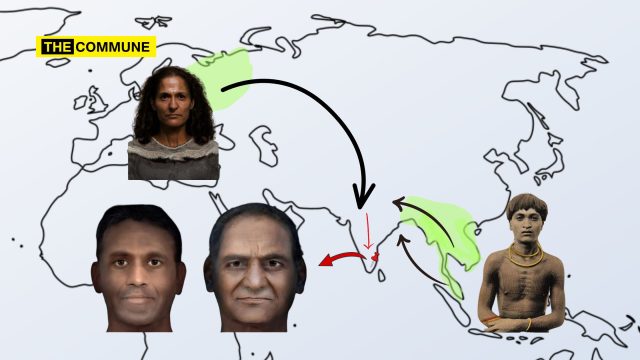
In a significant blow to the Dravidian narrative that sought to propagate the Aryan-Dravidian racial divide, recent findings have disrupted the foundations of that theory. A UK-based lab, in collaboration with Indian researchers, conducted facial reconstructions of two individuals from the Kondagai burial site. The results revealed that these ancient individuals were of South Indian origin, carrying ancestral links to West Eurasian (Iranian) hunter-gatherers and Austro-Asiatic populations. This discovery directly challenges the divisive Nazi style race-based narrative, as the latest report clearly states, “South Indian with traces of ancestral West Eurasian (Iranian) hunter-gatherers and ancestral Austro-Asiatic people.” With these findings, the attempt to sustain the Aryan-Dravidian binary appears to have hit a dead end.
Excavations at Keezhadi, located about 12 kilometers from Madurai, have revealed evidence of a thriving civilization dating back allegedly to the 6th century BCE. Now, for the first time, researchers have been able to put a human face to these ancient people. The facial reconstructions were carried out by experts at Liverpool John Moores University in collaboration with Madurai Kamaraj University.
Professor Caroline Wilkinson, head of the Face Lab at Liverpool, explained that a computer-assisted 3D technique was used to reconstruct the facial muscles and features of the skulls. While the upper halves of the skulls were largely intact and allowed for more accurate reconstructions, the missing lower jaws required researchers to estimate the shapes based on orthodontic standards and cranial measurements.
Using CT scans of the Kondagai skulls and anatomical data from modern South Indian populations, the team applied forensic and anthropological methods to estimate soft tissue depth and facial characteristics. The reconstructed appearances were finalized using digital modeling, with skin tone, hair texture, and eye color selected from a photographic database.
According to Professor G Kumaresan of Madurai Kamaraj University, the process involves a mix of science and interpretation about 80% based on scientific data and 20% on artistic estimation. These reconstructions, paired with DNA analysis, are expected to provide deeper insights into the ancestry and migratory patterns of people from the Sangam period.
Keezhadi has become a focal point of academic and political debates regarding the region’s historical timeline. Although the Archaeological Survey of India (ASI) recently suggested revising earlier dating of the site to the 3rd century BCE, Tamil Nadu’s state archaeology department maintains that radiocarbon analysis confirms human activity at Keezhadi from the 6th century BCE to the 2nd century CE.
In collaboration with Harvard University’s genetics department, researchers are conducting extensive DNA analysis of the skeletal remains from Kondagai to trace patterns of migration and admixture. Preliminary studies suggest that most individuals buried at Kondagai were around 50 years old at the time of death.
Anthropologist Veena Mushrif Tripathy from Deccan College examined the bones and confirmed that age estimations were based on features such as dental wear, joint conditions, and bone size. Of the remains, 11 skeletons allowed for stature estimates: the average male height was about 170.82 cm (5’7″), and the average female height was 157.74 cm (5’2″). These findings are consistent with data from Kodumanal, another archaeological site.
Sex determination was primarily done by analyzing pelvic and cranial features. Archaeologist K Rajan, who advises the Tamil Nadu archaeology department, noted that this project marks the first facial reconstruction of ancient individuals from South India a significant step forward in understanding the region’s historical identity.
Why Is This A Major Blow For The Dravidian Ecosystem?
Like the Nazis, Dravidianists believe in the racial purity of Dravidian race.
These findings directly challenges the core foundation of the Aryan-Dravidian theory also known as the Aryan migration or invasion theory, which claims that Indo-European (Aryan) groups migrated into India, subjugating or assimilating the native Dravidian-speaking populations. This narrative has long been used to assert that Dravidians were the original inhabitants, dispossessed of power, land, and legacy. Some proponents even went as far as to claim that the Dravidian race was the ancestor of all civilizations, including the Harappans, asserting a singular racial and cultural continuity through history.
With the Keezhadi excavations, there was a concerted effort to shift historical timelines and reinforce this theory through selective peer-reviewed interpretations. However, a single, scientifically grounded facial reconstruction of two skulls from the Kondagai burial site has undercut this narrative. The study revealed that these ancient individuals were South Indian, with genetic influences from ancestral West Eurasian (Iranian) hunter-gatherers and Austro-Asiatic populations effectively dismantling the idea of a racially pure or isolated Dravidian lineage. The evidence speaks for itself and strikes at the heart of an ideological construct that had long evaded scrutiny under hard science.
(With inputs from Times Of India)
Subscribe to our channels on Telegram, WhatsApp, and Instagram and get the best stories of the day delivered to you personally.