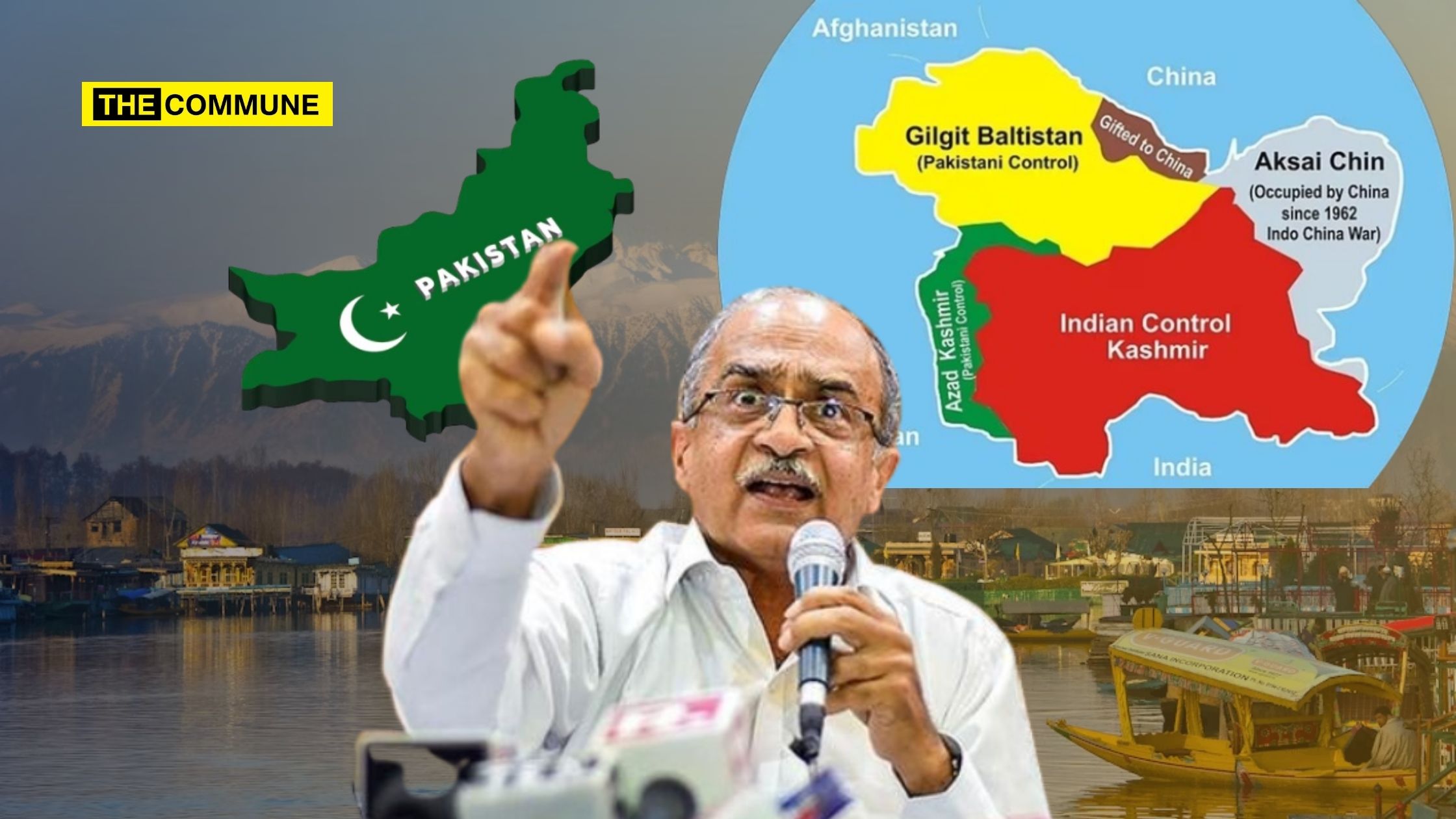
Supreme Court advocate Prashant Bhushan has long been a controversial figure in Indian public discourse. Once seen as a supporter of the Aam Aadmi Party and a fierce critic of the Congress-led UPA government particularly during the 2G and coal scam era. Bhushan later shifted roles to advising the same Congress party, raising eyebrows over his ideological consistency. Over the years, he has courted controversy not just for his legal activism, but also for his vocal stance on Kashmir, media narratives, and a soft corner for extremist elements, including Maoists.
What many might not know is that Bhushan has a history of taking positions on Kashmir that often align closely with Pakistan’s rhetoric from pushing for demilitarization to opposing infrastructure development and questioning counter-terror operations. Here’s a timeline of some of the most debated positions he has taken:
Advocating Plebiscite In Kashmir (2011)
At a press conference in Varanasi, Bhushan called for the repeal of AFSPA in Jammu and Kashmir, withdrawal of the Indian Army, and even a UN-backed plebiscite to determine if Kashmiris wanted to remain with India.
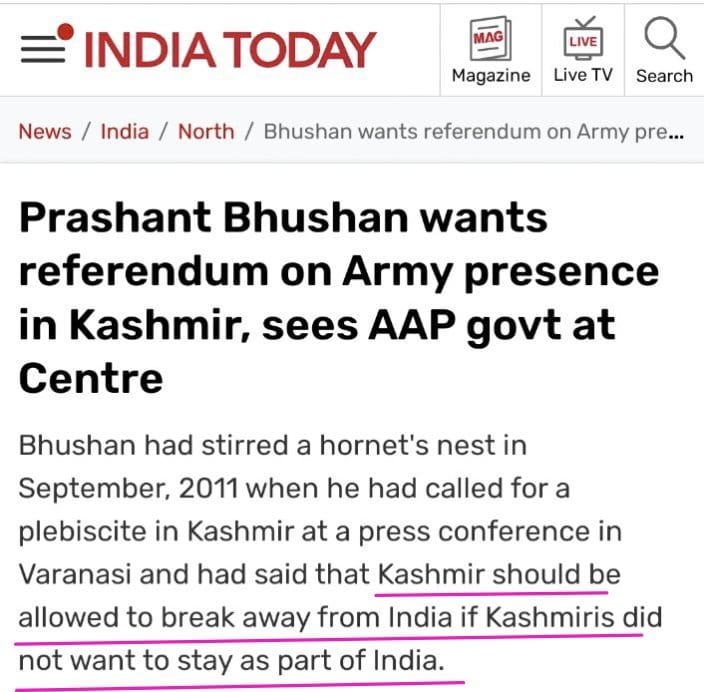
Implication? A plebiscite, as demanded by Pakistan for decades, would risk handing Kashmir to Pakistan. His remarks triggered public outrage, and he was even physically attacked at the event. Yet, this didn’t deter him from continuing with similar rhetoric.
Ouch, pic.twitter.com/5WS6J0kqKT
— Lady Khabri (@KhabriBossLady) September 26, 2024
Challenging The Chenab Railway Bridge (2013)
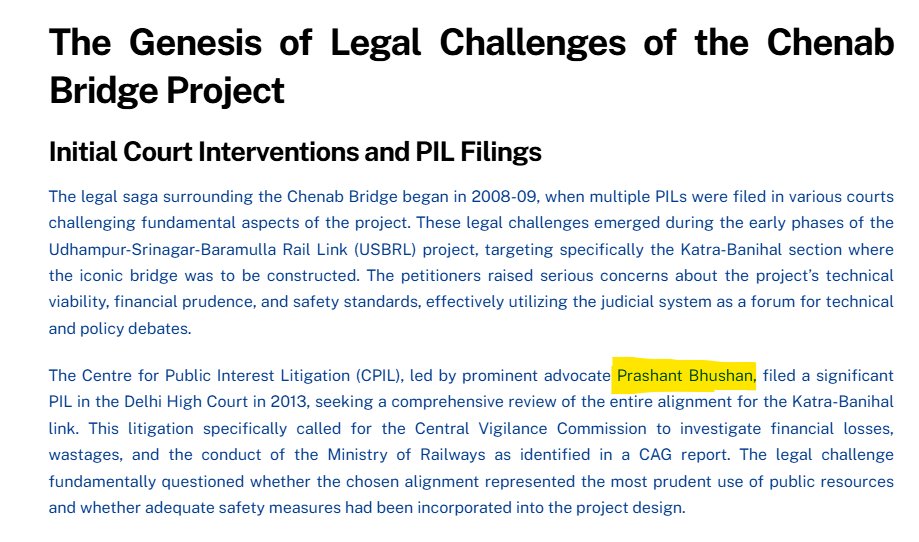
Bhushan filed a PIL in the Delhi High Court through the Centre for Public Interest Litigation (CPIL), demanding a review of the alignment of the Katra-Banihal rail link, which includes the Chenab Railway Bridge—a critical infrastructure project aimed at connecting Kashmir with the rest of India.
Critics argue this caused delays in a strategic project vital for regional integration and security. Was this just about “public interest,” or was there an attempt to slow development in Kashmir?
Repeating Call To Withdraw Army From J&K (2014)
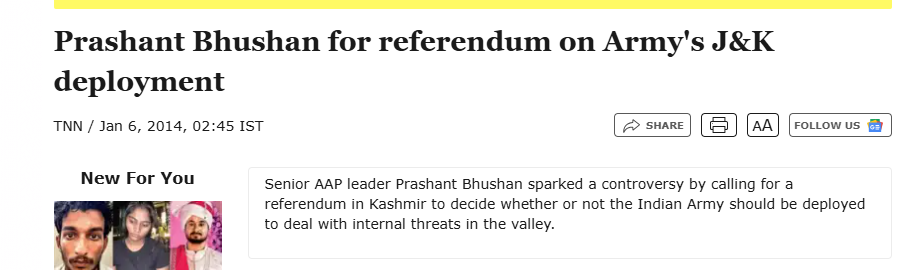
Bhushan again demanded the withdrawal of Indian forces from Kashmir, suggesting that the local population be “consulted” on the need for military presence. In a region facing continuous infiltration and terrorism, can the army be removed based on public sentiment alone?
Sympathizing For Terrorist Burhan Wani (2016)
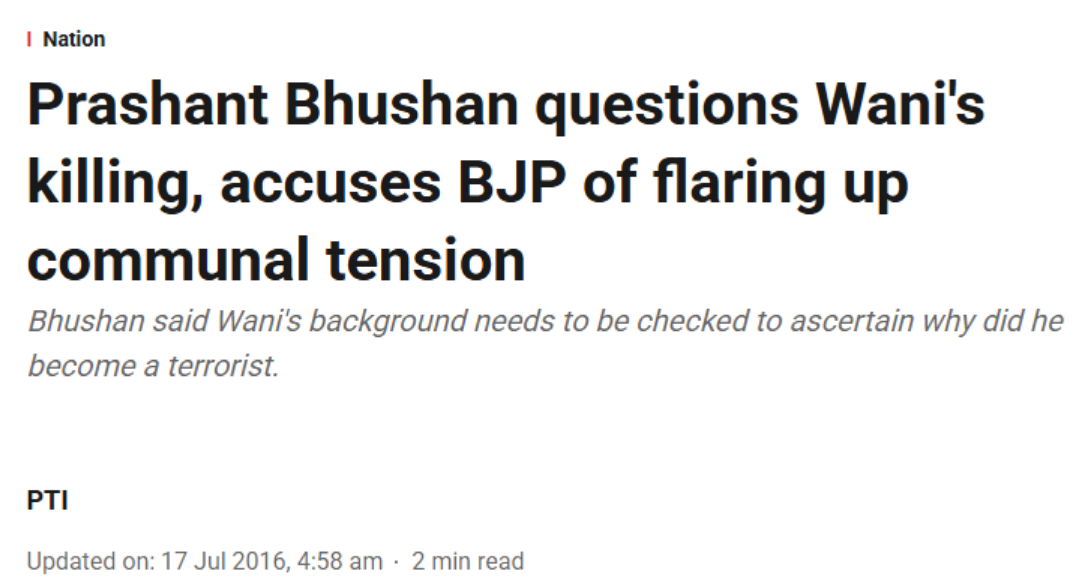
After the killing of Hizbul Mujahideen commander Burhan Wani, Bhushan questioned whether it was a fake encounter. He implied that Wani was radicalized because his brother was allegedly beaten by security forces, appearing to justify his path toward terrorism. He allegedly said, “Wani’s brother was beaten by security forces, fueled radicalization in Burhan” and questioned, “What feeling would this have generated in a 15-year old boy seeing his brother being beaten up by security men?”
This drew heavy criticism, as many viewed it as undermining national security and rationalizing militancy.
Justifying Pulwama Suicide Bomber 2019
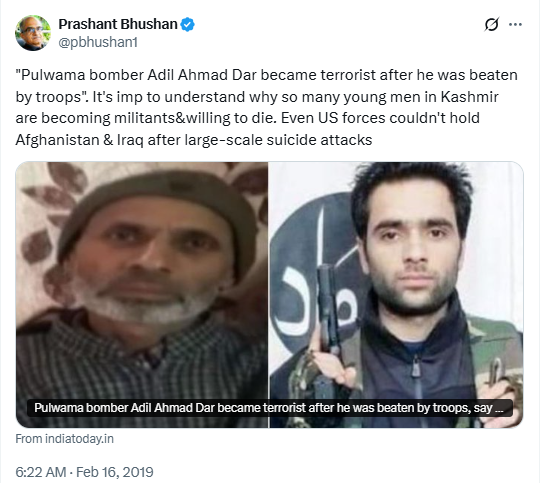
In a tweet following the Pulwama attack, where 40 CRPF personnel were martyred, Bhushan wrote that Adil Ahmad Dar became a terrorist after being beaten by troops, comparing the Kashmir situation to insurgencies in Afghanistan and Iraq.
Controversially Bhusan wrote, “Pulwama bomber Adil Ahmad Dar became terrorist after he was beaten by troops. It’s imp to understand why so many young men in Kashmir are becoming militants & willing to die. Even US forces couldn’t hold Afghanistan & Iraq after large-scale suicide attacks.”
Many found this deeply insensitive, interpreting it as rationalizing terrorism and blaming Indian forces rather than the perpetrators.
Opposing Revocation Of Article 370 (2019)
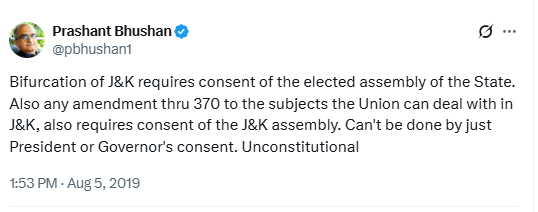
Bhushan opposed the scrapping of Article 370, calling it “unconstitutional” and claiming that it required the consent of the J&K assembly. He also criticized the Supreme Court’s judgment on the matter. This position, again, mirrored Pakistan’s objections almost word for word.
In a post he stated, “Bifurcation of J&K requires consent of the elected assembly of the State. Also any amendment thru 370 to the subjects the Union can deal with in J&K, also requires consent of the J&K assembly. Can’t be done by just President or Governor’s consent. Unconstitutional .”
Pushing For Removal Of President’s Rule In J&K (2022)
Representing the People’s Union for Civil Liberties (PUCL), Bhushan filed a petition to lift President’s Rule in J&K, arguing that elections must be held. The move was seen by critics as an attempt to politicize security decisions in a sensitive border region.
Amplifying Foreign Misinformation (2024)
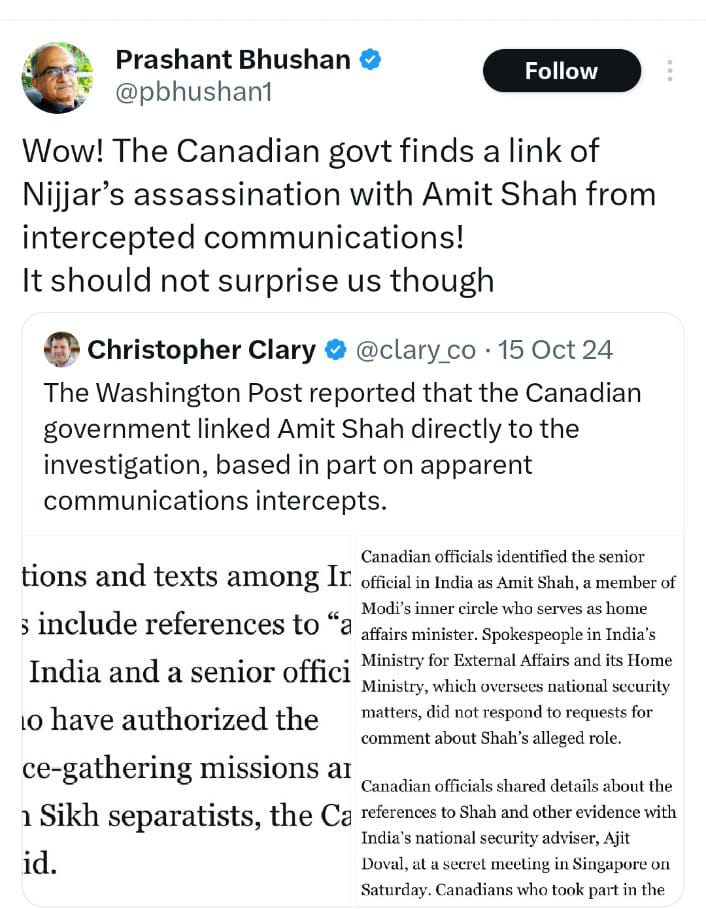
In 2024, Bhushan quoted Pakistani-sympathetic analyst Christopher Clary and responded to a dubious claim about Amit Shah’s alleged involvement in the assassination of Canadian Khalistani separatist Hardeep Singh Nijjar, based on a controversial Washington Post article.
Bhushan tweeted, “Wow! The Canadian govt finds a link of Nijjar’s assassination with Amit Shah from intercepted communications! It should not surprise us though .” Even though Canada never confirmed such a link, Bhushan’s tweet lent credibility to an unverified, fake narrative.
The Core Question remains, why do Prashant Bhushan’s views on Kashmir consistently mirror the position of Pakistan? From opposing military presence to resisting infrastructure, to defending known terrorists and echoing foreign propaganda, Bhushan’s record reveals a pattern of detrimental to national interests. This post isn’t just about one person’s opinions—it raises deeper concerns about legal activism being used to push geopolitical narratives that may not align with India’s sovereignty and security priorities.
(This article is based on an X Thread By Starboy)
Subscribe to our channels on Telegram, WhatsApp, and Instagram and get the best stories of the day delivered to you personally.