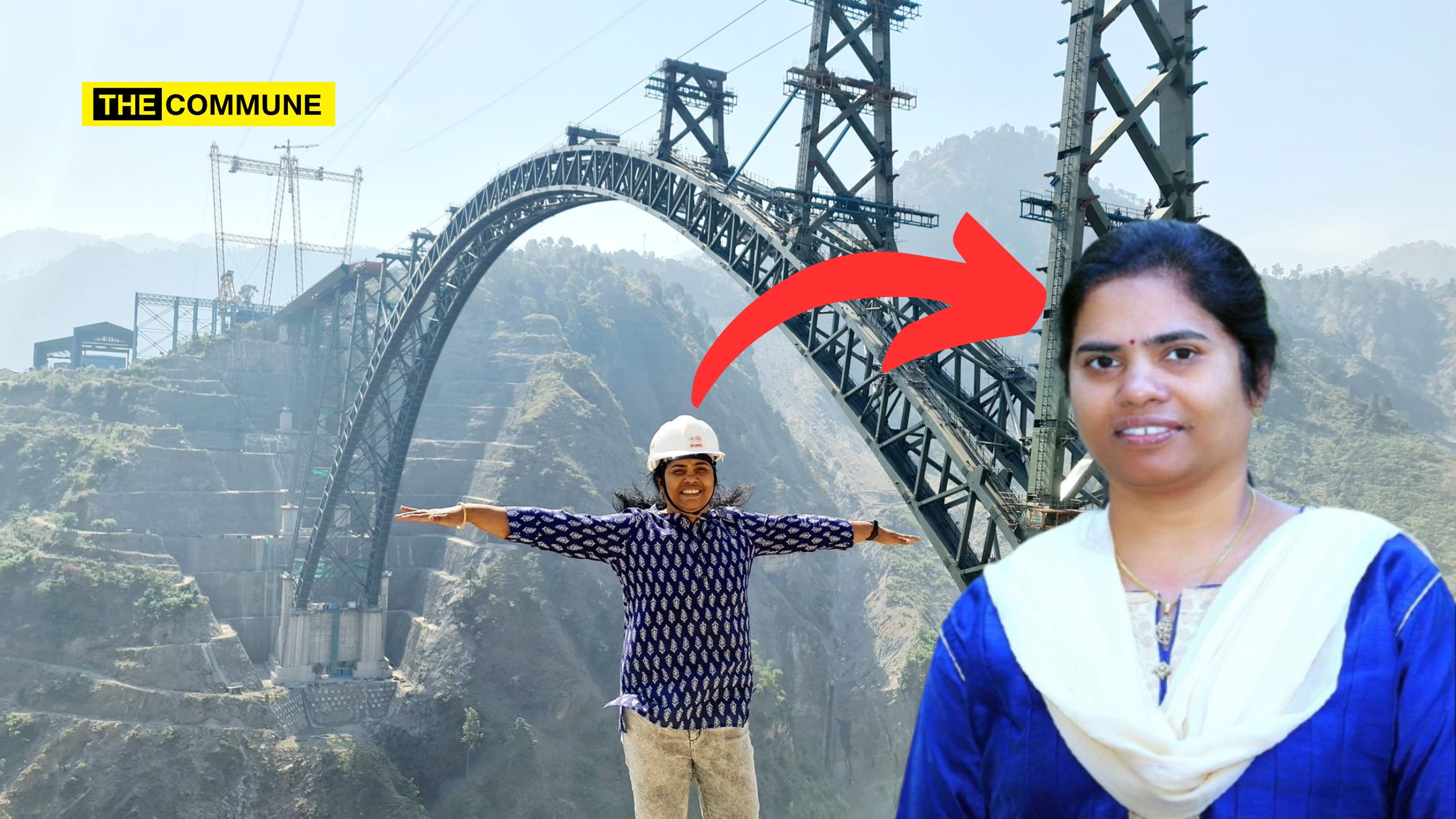
You’ve probably admired the stunning vistas of the Chenab Rail Bridge — the tallest railway bridge in the world.
But have you heard the story behind its creation? Let’s explore the lesser-known journey of the remarkable woman who played a key role in making it a reality: Professor Gali Madhavi Latha.
Prof. Gali Madhavi Latha is the geotechnical engineer whose expertise helped shape the engineering marvel that is the Chenab Rail Bridge in Kashmir. Spanning 17 years of effort, this structure is not just a bridge — it’s a testament to human ingenuity and perseverance.
Towering at 359 meters — higher than the Eiffel Tower — the Chenab Bridge links Kashmir to the rest of India through the rail network. It’s more than an infrastructure feat; it’s a powerful emblem of national integration and engineering excellence.
Back in 2005, Northern Railway enlisted Prof. Latha as the lead geotechnical consultant. Her mission? Conquer the harsh Himalayan terrain, stabilize fractured rock slopes, and make an audacious vision possible.
Holding a PhD in Geotechnical Engineering from IIT Madras and backed by research from IISc Bangalore, she was well-versed in the science of rock and soil mechanics. But the Chenab project posed unprecedented challenges that would push even the most seasoned expert to the limit.
She trekked through rugged landscapes, crossed rivers in boats, and examined complex geological formations in a region prone to earthquakes. The extreme conditions weren’t deterrents — they were simply part of the job.
Her approach was unconventional yet necessary: a dynamic, “design-on-the-go” method. Standard engineering formulas wouldn’t hold up against the unpredictable Himalayan geology, so she adapted strategies on-site and devised solutions in real time.
When unstable rock formations and hidden cavities were discovered, she led large-scale operations involving cement grouting and rock anchoring — reinforcing the slopes with over 66 kilometers of anchors, effectively stitching the mountain together.
At times, she stayed on-site around the clock, guiding excavation teams through high-risk situations where a single miscalculation could lead to catastrophe. Her work demanded accuracy, courage, and constant vigilance.
The bridge was engineered to endure extreme forces — winds of up to 260 km/h and earthquakes exceeding magnitude 8. It was Prof. Latha’s geotechnical designs that ensured the bridge could withstand such pressure while remaining safe and stable.
After nearly two decades of dedication, she finally visited the completed bridge in 2022 — not in her professional capacity, but as a mother, showing her children what determination and expertise can accomplish.
In 2021, she was honoured as the Best Woman Geotechnical Researcher by the Indian Geotechnical Society. Though the Chenab Bridge may be her most iconic work, her contributions to the field extend far beyond it.
She served as Editor-in-Chief of the Indian Geotechnical Journal from 2016 to 2022 and continues to mentor aspiring engineers at IISc Bangalore. For her, building infrastructure is only part of the mission — the rest is about inspiring the next generation.
On June 4, 2025, the Chenab Bridge hosted its first Vande Bharat Express test run — a milestone for Indian Railways and for national pride. Behind that moment was the quiet brilliance of Prof. Latha’s foundational work.
Today, the Chenab Rail Bridge stands as a global symbol of Indian engineering prowess. And beneath its towering steel and concrete lies the unwavering legacy of Prof. Gali Madhavi Latha — the woman who, quite literally, moved mountains.
Subscribe to our channels on Telegram, WhatsApp, and Instagram and get the best stories of the day delivered to you personally.