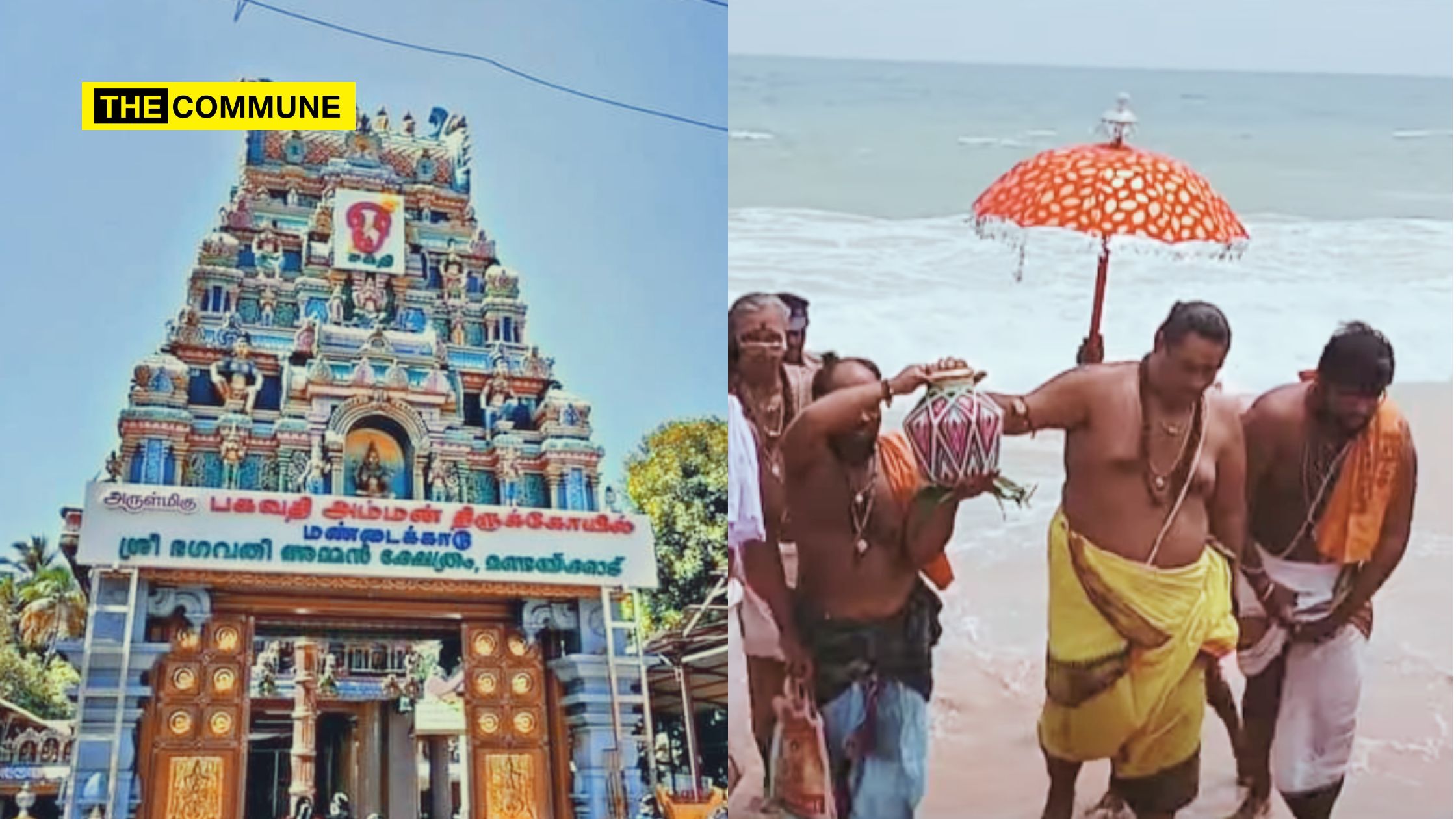
The recent incident at the historic Mandaikadu Bhagavathi Amman Temple in Tamil Nadu where members of the Church obstructed Hindu priests from performing the sacred ritual of collecting sea water reveals deeper currents of religious intolerance and underscores the ongoing marginalization of Hindu practices, often masked as efforts to uphold communal harmony.
Two weeks ago, the temple hosted its sacred kumbhabhishekam ceremony, a ritual symbolizing the spiritual renewal of the shrine following a destructive fire in 2021. Central to this rite was the age-old tradition of the head priest riding an elephant to the sea, carrying the kalasam (sacred pot) filled with consecrated water. This symbolic journey, performed for generations, unexpectedly encountered resistance.
As the procession moved toward the sea, it passed a now-prominent shrine dedicated to ‘Mary‘, which originally began as a modest crucifix tower. There, individuals reportedly forced the priest to dismount the elephant, compelling him to complete the sacred journey on foot. This deviation from ritual protocol sparked concern among devotees, especially given the temple’s status as the “Sabarimala for women,” where thousands of female pilgrims from Tamil Nadu and Kerala come for spiritual cleansing and worship.
This interruption is seen by many as more than a logistical hurdle. The portrayal of Mary as a “sister” to the Goddess, while seemingly inclusive, is viewed by some scholars and observers as an attempt to subtly subordinate or reframe Hindu theology through appropriation. Over time, the Mary shrine has grown in size and influence, fostering a sense of competition with the older Bhagavathi temple.
Despite the Church’s promotion of interfaith dialogue and mutual respect, critics argue that on the ground, tensions remain unresolved. The Dravidianist media coverage of the incident varied—many ignored the core issue entirely, while some praised the priest’s composure and interpreted the act as a gesture of peace, rather than a breach of religious tradition.
This moment of disempowerment, where a priest had to relinquish a symbolic element of his ritual journey, resonated with historical memory particularly the violence of 1982.
The 1982 Mandaikadu Riots
In the early 1980s, the Mary shrine was in its infancy. However, tensions flared when Hindu women performing ritual sea baths were reportedly harassed by Catholic extremists. Eyewitness accounts described disturbing scenes of humiliation and fear, leading to police intervention and fatalities. The unrest quickly spread, resulting in attacks on Hindu villages and a wave of retaliatory violence.
Amidst the chaos, posters criticizing India and then-Chief Minister M.G. Ramachandran appeared, raising suspicions of politically motivated incitement. In response, the Tamil Nadu government established an inquiry under retired Justice Venugopal, known for his affiliation with the Dravidian movement. While initially skeptical of Hindu nationalist groups, his final report acknowledged the aggressive conduct of Christian fundamentalists as the root cause of the violence.
Justice Venugopal’s later writings reflected a significant shift in his perspective. He supported anti-conversion legislation and highlighted the need to protect vulnerable communities from coercive religious tactics.
One of the most harrowing parts of the Commission’s report involved testimonies from Hindu women victims. A 19-year-old woman described being assaulted and stripped of her clothing while trying to bathe as part of temple rituals. Despite facing hostile cross-examinations, the consistency of her account and others moved the judge to affirm their credibility. The report concluded that women devotees were indeed harassed and molested during the 1982 disturbances.
Evolving Dynamics and Persistent Challenges
Though large-scale violence has not recurred in recent years, undercurrents of tension remain. The early post-riot years witnessed a consolidation of Hindu identity and political organization, but momentum has waned. In contrast, the Catholic Church has adopted a more strategic, institution-based approach, expanding its influence via social services, educational institutions, and community engagement.
Critics argue that the narrative of shared divinity—referring to Mary as a sibling to the Goddess—serves a dual function: placating resistance while subtly diminishing Hindu spiritual frameworks. Marxist and leftist scholars, often aligned with this view, have reinterpreted Hindu deities through an anthropological lens, detaching them from their metaphysical roots and portraying them as mere cultural relics.
The spread of this interpretation has been bolstered by literature, notably the novel Marupakkam by Ponnelan, which presents a sympathetic portrayal of Christians and casts Hindus in a negative light. Due to a lack of a strong Hindu literary counter-narrative, such works have come to define public memory about events like the 1982 riots.
Institutionally, the Church has made inroads into Hindu-majority rural economies—exemplified by control over local dairy cooperatives—and transformed religious centers into platforms for socio-political outreach. These shifts have coincided with a decline in cohesive Hindu mobilization, making the community more susceptible to symbolic losses.
Recent Developments and Ongoing Tensions
The Venugopal Commission once recommended restrictions on religious structures in sensitive zones. However, the post-2004 political climate saw a resurgence in Church-led expansion. One flashpoint involved the blocking of access to a hillock traditionally used by Hindus for the Karthikai Deepam festival, now part of Church-owned land. Despite intervention by political figures like Pon. Radhakrishnan, efforts to reclaim access failed.
Other incidents—such as the removal of a Hanuman idol installed with official approval—suggest that Church influence often overrides local administrative decisions. The latest provocation, involving the forced dismounting of the priest, has been viewed by many as a culmination of this trend.
Observers note that while Hindu groups issued statements, their response lacked the organizational strength and strategic clarity shown by the Church and its affiliates. The disruption of the elephant procession thus stands not merely as a logistical problem, but as a symbolic erasure of sacred tradition.
In summary, the Mandaikadu episode underscores the need for sustained community engagement, cultural preservation, and balanced interfaith dialogue. Without a cohesive strategy and a deeper understanding of institutional dynamics, moments like this risk becoming markers in a larger narrative of displacement.
(With inputs from Swarajyamag)
Subscribe to our channels on Telegram, WhatsApp, and Instagram and get the best stories of the day delivered to you personally.