A major controversy has erupted at the Indian Institute of Technology Gandhinagar (IITGN), where the Humanities and Social Sciences (HSS) department is under fire for promoting ideologically charged research topics, many of which center around Islamic theology. The situation has sparked national concern, with calls for the Ministry of Education and the IIT Council to investigate the use of taxpayer-funded resources for what critics are calling “ideological indoctrination.”
At the center of the controversy are several MA-level thesis projects approved and supervised by faculty members at IITGN. These projects, according to students and critics, do not approach religious themes through critical academic frameworks but instead seem to endorse theological perspectives under the guise of social science research.
Among the topics that have drawn scrutiny are: “Robes of Authority: Sunni Ulama, Sartorial Tradition, and Embodied Piety in Malabar,” “Fishing With Faith: Islam, Indigenous Knowledge and Ecological Sustainability in Lakshadweep,” and “From Gods to Jinn: Ontological Rewriting and the Islamization of Spirits in Kerala.” Critics argue that such topics resemble theological glorification rather than academic inquiry, particularly in a technical institution originally meant to promote scientific research and innovation.
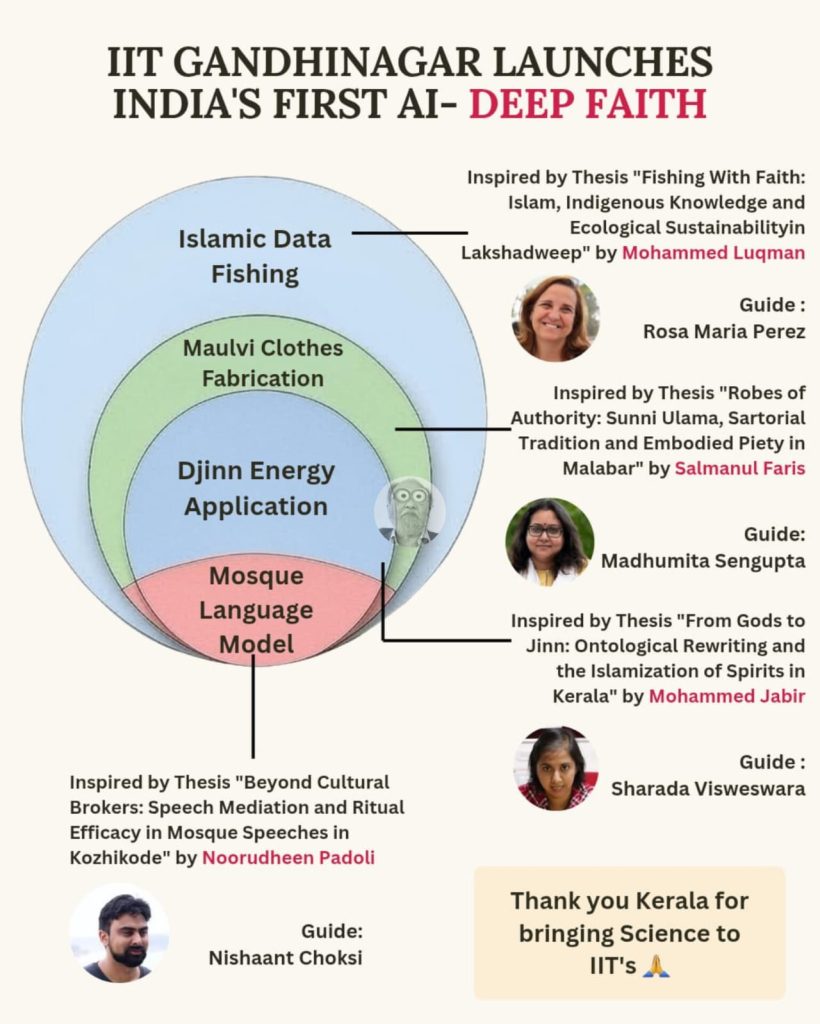
These thesis topics were submitted by three MA students—Muhammed Luqman, Salmanul Faris, and Mohammed Jabir—and approved by faculty members including Nishaant Choksi, Rosa Maria Perez, Madhumita Sengupta, and Sharada Visweswara. The approval also granted these students access to institutional resources and funding, drawing sharp questions about how government funds and public infrastructure are being utilized in institutions like IITs.
Here is the original research that has gone into this great Islamic study. I request IIT Gandhinagar to take up a new project that will help identity Kafirs through the fear in their voice even if they memorize kalma. Let's create more application oriented research shall we? pic.twitter.com/LNNTgQm1J3
— Eminent Intellectual (@total_woke_) April 28, 2025
Several Hindu students at IITGN raised objections to what they saw as overtly religious and ideologically slanted research. They expressed concern that a technical institute like IIT should not be allocating funds and academic legitimacy to topics that could have been more appropriate in a religious or theological university. According to student accounts, their opposition was met with threats of academic retaliation, including the possibility of being failed, penalized, or subjected to disciplinary committees.
@iitgn needs to give a clarification over all this BS going on, instead of threatening the students.
STOP THREATENING THE HINDU STUDENTS! pic.twitter.com/ffPkQyVrer
— Indian Right Wing Community (@indianrightwing) May 1, 2025
An email by Professor Nishaant Choksi, now circulating on social media, allegedly warned students of “consequences” for leaking thesis topics and related information. In his email, Choksi invoked the institute’s “honor code” and characterized the disclosure of internal academic work as a serious breach, prompting further concern about the lack of transparency within the department.
🚨 This is scary. Our students are not safe in an environment of academic intimidation, secrecy & sexual exploitation.
After I exposed Islamic idiocy being studied in @iitgn, this is the mail one of the professors Nishaant Choksi sent.
He talks about an "Honor code" as if they… https://t.co/2XP4hWvNhc pic.twitter.com/PJIjvRX8KK
— Eminent Intellectual (@total_woke_) April 30, 2025
Adding to the alarm, some students allege that IITGN has become increasingly hostile to Hindu sentiments. In the aftermath of the recent terror attack, students say the administration denied permission for a candle march in response to the Pahalgam terror attack, while simultaneously allowing events viewed as sympathetic to the Palestinian cause shortly after the October 7 Hamas terror attack.
The administration of @iitgn recently denied any protest or solidarity march regarding the Pahalgam Terrorist attacks. pic.twitter.com/MdGProrShg
— Indian Right Wing Community (@indianrightwing) May 1, 2025
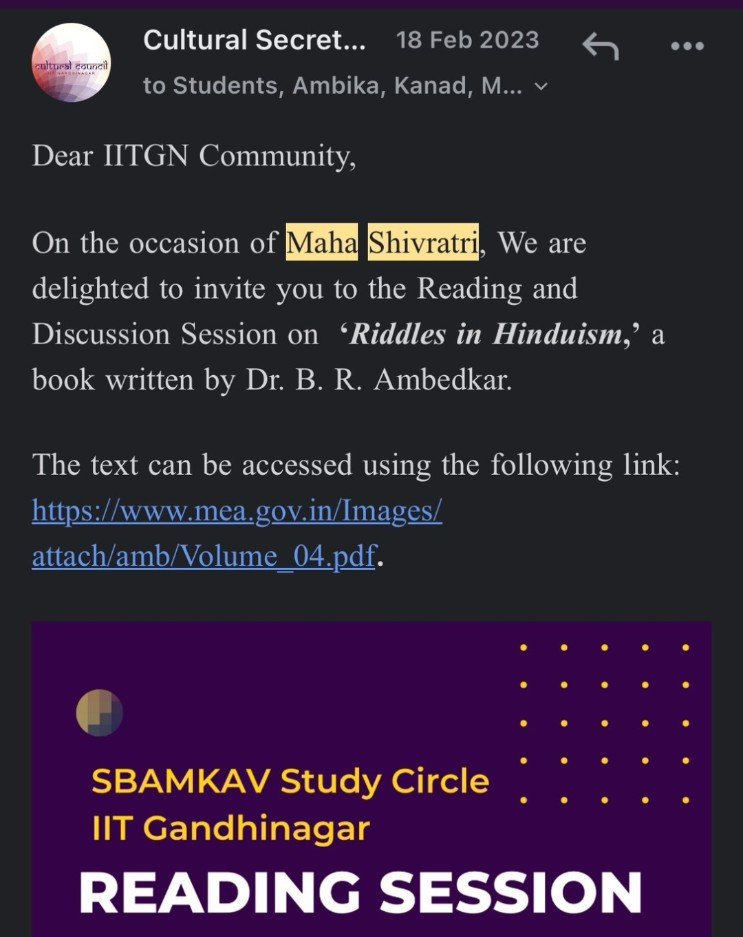
They also cite past events where religious Hindu festivals faced administrative pushback—such as restrictions on Diwali celebrations—while events critical of Hinduism, including readings from B.R. Ambedkar’s “Riddles in Hinduism” on Mahashivratri, were allowed to proceed.
One particular student society, “Awaam,” has come under the spotlight for its programming, which has included lectures on “Brahminical Oppression of Women” and support for causes perceived as anti-India or anti-Hindu. The department also reportedly hosted lectures on Periyar and organized a birthday celebration for the controversial Dravidian figure, merely 10 km from the Chief Minister’s office.
Periyar Jayanti celebration in IIT Gandhinagar.
You know which department is this.
I repeat: catapult the person who gave idea of opening humanity departments at IITs. pic.twitter.com/6EMpnaT0fb
— Harshil (હર્ષિલ) (@MehHarshil) May 1, 2025
These incidents have ignited a larger debate about the role and accountability of Humanities departments within IITs. Many critics argue that these departments operate with ideological bias, shielded by the label of academic freedom but unchecked by the scrutiny applied to scientific and technical departments. Calls are growing for either the removal of such departments from IIT campuses or their restructuring to ensure ideological neutrality and transparency.
The administration of IITGN, including Director Rajat Moona and Dean of Student Affairs Shivapriya Kirubakaran, has yet to publicly address the specific allegations. Students claim that those questioning the department’s practices have faced increasing institutional pressure.
There is growing consensus that IITs—institutions that have played a pivotal role in India’s technological rise—must not become platforms for ideological experiments under the cover of academia.
If the allegations are substantiated, this episode could mark a turning point in how humanities programs are regulated within elite technical institutions. For now, all eyes remain on IIT Gandhinagar and the response of India’s higher education leadership.
Subscribe to our channels on Telegram, WhatsApp, and Instagram and get the best stories of the day delivered to you personally.