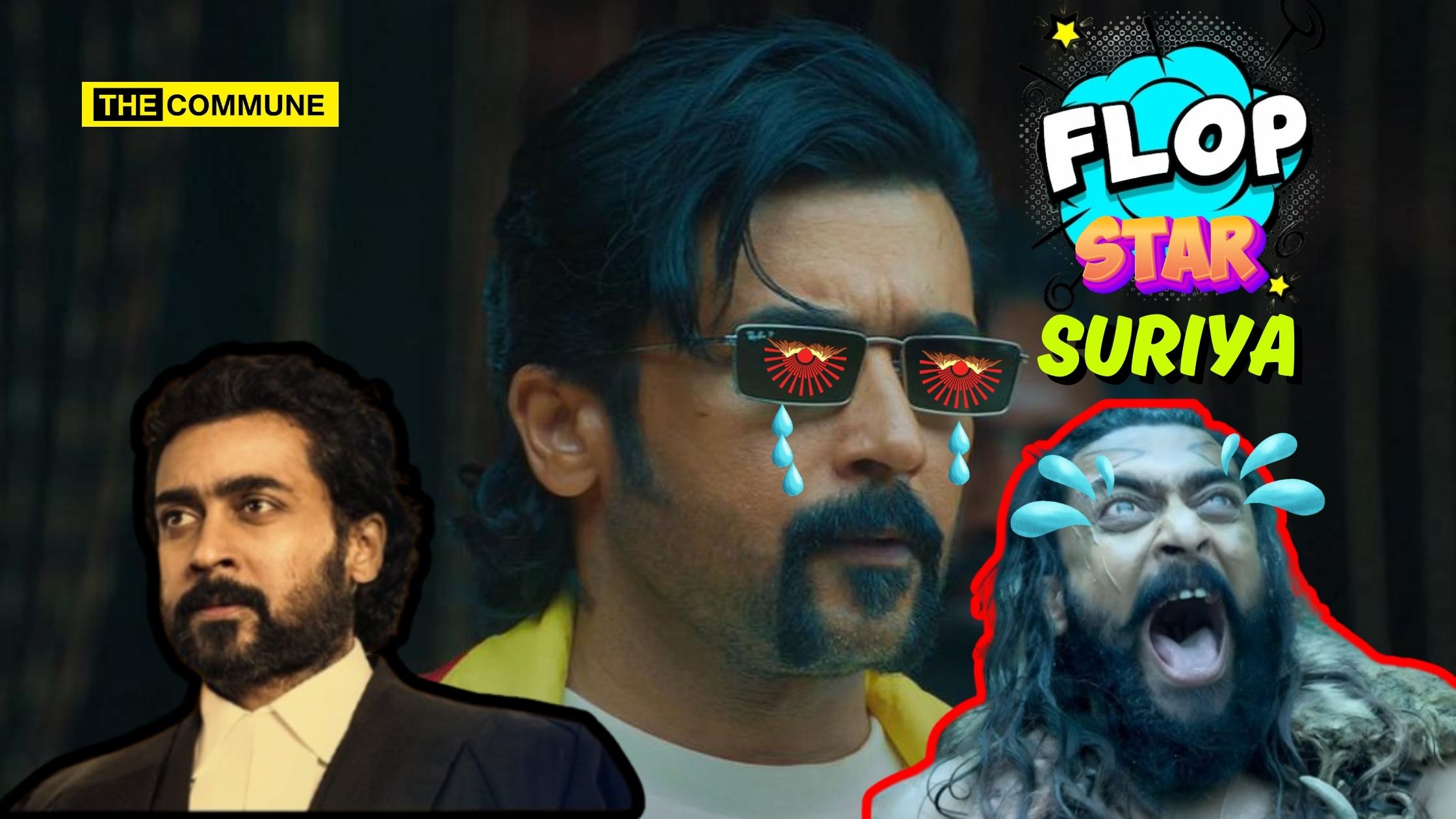
Suriya who had peddled canards and hatred against Brahmins and Vanniyars in his film Jai Bhim is now facing the wrath of karma as the actor has hit a record of hattrick flops.
The nefarious propagandist actor who used his stardom to virtue signal is now being made to bite the dust.
Many moviegoers walked into theatres with high hopes for Retro, believing it to be a powerful comeback for Dravidianist actor Suriya. However, their faith wasn’t solely in him—it largely rested on three pillars: director Karthik Subbaraj, music composer Santhosh Narayanan, and the viral buzz surrounding the song “Kanimma.” Yet, the final product left audiences baffled.
Instead of offering a fresh cinematic experience, the film seemed to recycle elements from Karthik Subbaraj’s previous works, creating a collage of familiar visuals and themes from his own “cinematic universe.” Even the much-hyped “Kanimma” song failed to recreate the experience on screen, with the soundtrack being the only mildly redeeming aspect of the movie.
What viewers hoped would mark Suriya’s grand comeback ended up feeling more like an underwhelming sequel to Kanguva. With sluggish pacing and uninspired execution, Retro has drawn criticism from all corners—be it Tamil audiences, Malayalam viewers, or even international fans. Instead of cheering for Suriya’s return, many seem to be enjoying the film’s roast-worthy reception online.
Adding fuel to the fire, well-known Tamil reviewer “Blue Sattai” Maran of Tamil Talkies tore the film apart in his review. His sharp critique, dissecting the movie scene by scene, echoed the sentiments of disappointed fans and served as a loud warning to those who hadn’t yet seen the film.
Maran began his review by pointing out that the film lacked any coherent logic, instead wandering aimlessly in an attempt to tell a story that left audiences disconnected and confused. Mocking the film’s narrative structure, he sarcastically remarked, “This story jumps to the Ramayana, the Mahabharata, to the Itihasas and Puranas, then travels through the 1960s, 70s, 80s, and even to the B.C. era—only to tell some ghost story. And that’s supposed to be the story!”
Then he roasted the story’s plot stating, “In cinema, experienced writers and screenwriters often mention a particular phrase, which is, ‘A good story will demand and bring in the right scenes it needs on its own.’ That’s how a strong story takes shape. But there’s something they don’t usually say, just like that, a lousy (or mokka) story will also naturally demand equally and adds lousy scenes, and that all lousy scenes together piled up a story is Retro.”
Maran then pointed out another major flaw: a compelling story needs a strong, clearly defined villain. But in Retro, the audience is left confused—was the villain Joju George? Prakash Raj? Nassar? Or maybe even Nassar’s son? The identity of the antagonist itself feels like a mystery. He remarked that if the villain’s role is so ambiguous, how can the character be expected to carry any real weight? Ultimately, the film fails on that front too.
He also criticized the film’s erratic and illogical setting transitions starts from Thoothukudi to Kashi, then randomly to Africa and the Andaman Islands—without any explanation or narrative sense.
Maran said, “The story that starts in Thoothukudi goes all over the place. A lady dies in Thoothukudi, but we don’t know why they take her body and bury her in Kashi. Then suddenly, the story shifts to Africa. From there, it moves to the Andaman Islands, and again, we have no idea why. Once it reaches the Andamans, what does the villain does there? he’s keeping slaves and making them fight like gladiators. And you know how gladiators are, right? He’s got 10 people lined up side to side like it’s Saturday sacrifice day, and laughing at their fight. Then there’s a big well, filled with crocodiles. They start throwing people into it and tossing kids in it. They’ve reused leftover dolls from Kanguva. Out of nowhere, they bring in Jayaram for ‘laughter therapy’ and try to make a comedy scene out of it. But it just doesn’t work not even a little. If they had tried a comedy scene and it didn’t land, that’s one thing. But here, they said, ‘This is laughter therapy, we’ll make you laugh,’ and tried hard and still, no one laughed, what to do. Then, finally, there was one genuinely funny moment in the film, when they were prepping Suriya’s getup, they dressed him looked like the Redin Kingsley that was hilarious for us… even though the film treated it seriously. Yet, it was hilarious for us.”
In one brutally honest line, “Blue Sattai” Maran summed it up in sync with audience sentiment—many now see Kanguva as the better film by comparison. He suggested that Retro might only be seen in a positive light if an even worse movie comes out next, and until then, viewers are better off spending their time elsewhere.
Subscribe to our channels on Telegram, WhatsApp, and Instagram and get the best stories of the day delivered to you personally.