In the annals of Indian history, there runs a dark, unbroken thread—a thread woven from centuries of conquest, humiliation, and violence that began with the Islamic invasions of the subcontinent. From the destruction of the temple by Mahmud of Ghazni, to the mass slaughter of innocents under Aurangzeb’s tyranny, the story of Islamic radicalism is not one of isolated acts, but of a sustained ideological war against the Indian civilization, especially its spiritual spine: the Sanatana Dharma.
And yet, even after centuries of bloodshed, even as the soil of India drank the tears and blood of its children, we as a nation have been taught not to remember, but to forget. To forgive without reckoning. To move on without reflection. Our education system, our intellectual circles, our mainstream discourse—each has sanitized history to fit a narrative of appeasement, of imposed harmony, of false equivalence. The trauma of Hindu civilization has been buried under layers of euphemism and academic erasure.
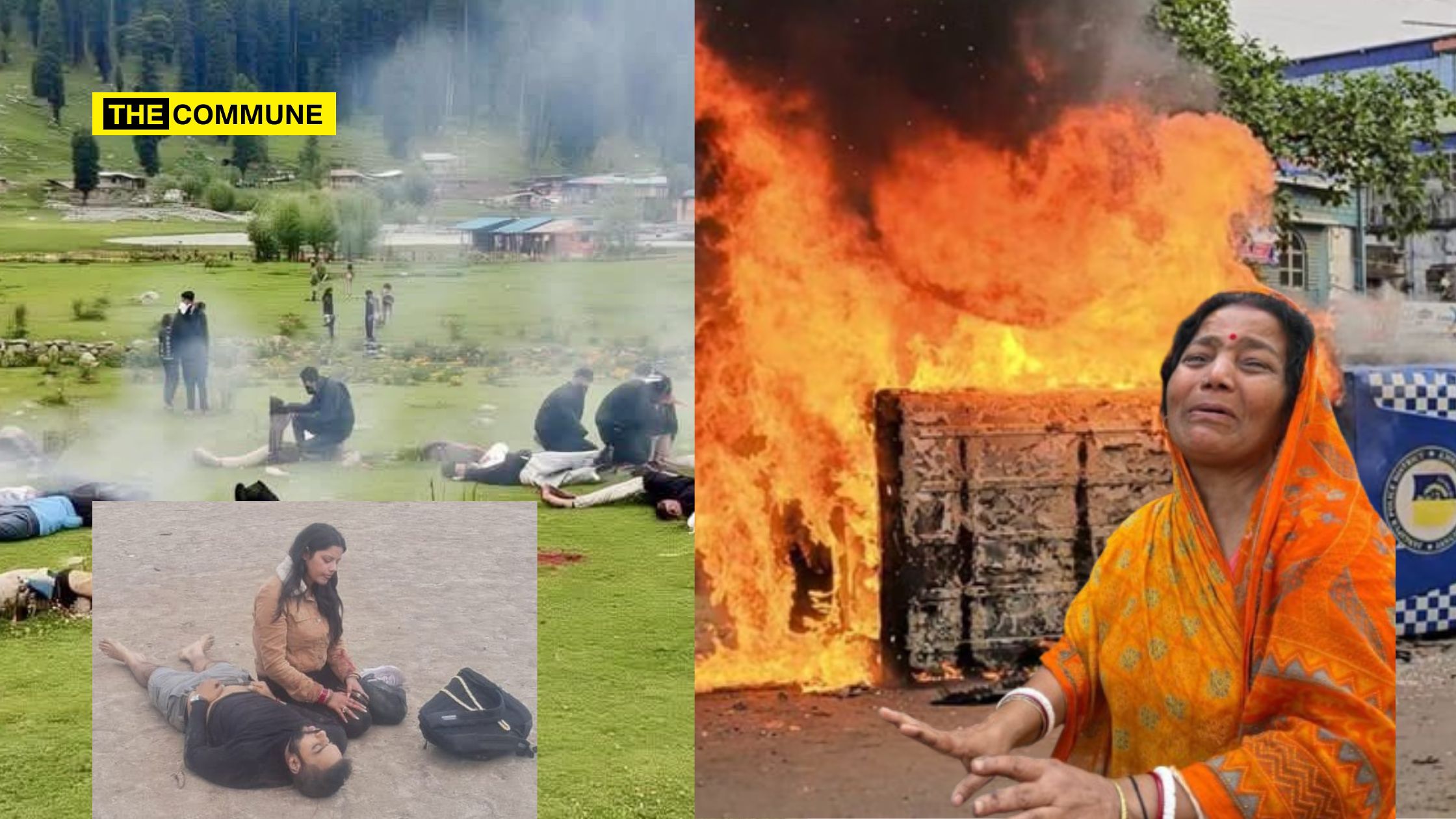
But truth does not die—it waits. The ideology that razed Somnath, Ayodhya, Kashi, and Mathura did not vanish with the Mughals. It did not end at Partition. It lives, mutated and emboldened, finding new names and faces, operating from Madrassas and terror cells, from pulpits and political backrooms. It now casts its shadow in Pahalgam and Murshidabad, in Udaipur and Kashi—not as an echo of the past, but as a continuation of an unbroken civilizational assault.
Still, we remain unwilling to name this enemy. We remain shackled by the fear of being labelled intolerant, communal, or regressive—while the very forces that thrive on division and destruction march onward, cloaked in the language of rights and pluralism. Our silence is not virtuous; it is complicit. It gives safe harbour to those who once led elephants into temple sanctums to desecrate the murtis, who now walk in courtrooms and corridors of power under the protection of law and the banner of secularism.
The time for silence is over. The time for euphemism is past. A nation that forgets its wounds opens them again. A civilization that will not defend itself—culturally, spiritually, and intellectually—invites its own demise.
The Cost of Cowardice: Murshidabad to Pahalgam
In Murshidabad, Hindus were hacked to death in their own homes. Their screams dissolved into the night; their blood washed away by the silence of a nation too afraid to confront the truth. There were no candlelight vigils in the heart of Lutyens’ Delhi, no emotional op-eds in national dailies, no hashtags trending in righteous indignation. The machinery that mobilizes outrage at the faintest perceived injustice was conspicuously still. Why? Because the victims were inconvenient. Their deaths did not fit the curated script of selective secularism.
Instead of naming the ideology behind the butchery, the headlines whispered of “local tensions”—a grotesque euphemism for jihadist hate. That silence was not neutrality. It was betrayal. And that cowardice—disguised as balance—gave courage to the butchers of Pahalgam.
Pahalgam was not an isolated event. It was a statement of intent. It was a war cry from the ideological successors of those who ravaged this land for centuries. It was a chilling reminder that the enemies of Bharat are not sleeping—they are evolving, rebranding, and striking with calculated precision.
The Resistance Front (TRF), the group that claimed responsibility, is not some organic Kashmiri uprising—it is the modern avatar of Lashkar-e-Taiba, the same Pakistani state-sponsored hydra that masterminded 26/11. TRF is nothing more than a PR facelift—a sophisticated deception designed to confuse the West, dodge blacklists, and maintain the charade of “local dissent.”
But the greater threat is not merely across the border. It is within. TRF and its handlers thrive because they are shielded, knowingly or unknowingly, by a network of enablers embedded in India itself. These are the so-called activists who cry for human rights only when the perpetrator fits a convenient profile. These are the media houses that cloak terror in neutral tones, the academics who romanticize radicalism in the name of “resistance,” and the politicians who appease for votes while graves are dug for innocents. It is this internal sabotage—this ideological treason—that emboldens the jihadist playbook.
The cost of cowardice is measured not just in corpses, but in the corrosion of a nation’s will. Each time the state hesitates to call jihad by its name, each time the media deflects, and each time the intellectual class offers false equivalence, the enemy gains ground. What happened in Murshidabad was a warning. What happened in Pahalgam was the proof.
The Domestic Enablers: India’s Opposition and Intellectual Cowards
Who nurtured the environment where such extremism could take root again? Who allowed the Kashmir narrative to drift from justice for the lakhs displaced Kashmiri Pandits to teary-eyed editorials for stone-pelters who maim soldiers and shield terrorists? The answer lies not in Pakistan alone—but in the polished drawing rooms of Delhi, in TV studios where the truth goes to die, and in the corridors of power where India’s political opposition and their intellectual foot soldiers operate with surgical precision.
It is they who turned the discourse from victim justice to terrorist empathy. It is they who humanized the gunman and demonized the soldier. They manufacture outrage for distant deaths in Gaza yet scroll past the hacked bodies in Murshidabad. When a terrorist is neutralized in the Valley, it is Rahul Gandhi who questions the army’s actions and lectures about “dialogue.” It is Mehbooba Mufti who cries crocodile tears for “our boys,” never once mentioning the officers martyred by their bullets. When Pulwama happened, it was not Pakistan but the Indian opposition that ran to court, demanding “proof.” That is not dissent. That is disgrace.
Let us talk about the media darlings, the left-liberal intelligentsia—those with column inches in The Wire, The Caravan, and NDTV. When the Gyanvapi revelations surfaced, they scoffed at centuries of desecration as “Hindutva propaganda.”
When Nupur Sharma quoted Hadiths, they blamed her for the beheading of Kanhaiya Lal. Not the killer. Not the ideology. But the one who dared to speak. Arundhati Roy once called for Kashmir’s “freedom.” She is still feted in Western universities and local literary festivals; never mind the seditious rot she spreads.
Ramachandra Guha, who prides himself as a historian, rarely finds space in his volumes to acknowledge the genocides of Hindus through centuries—unless to add “context” that somehow absolves the perpetrators. Rana Ayyub cries foul over Islamophobia abroad while conveniently silent on Hindu girls abducted and converted under coercion.
These are not just acts of omission—they are acts of betrayal. Betrayal of memory. Betrayal of martyrdom. Betrayal of the very idea of India. In the name of secularism, they defend the intolerant. In the name of harmony, they silence the truth. In the name of intellectualism, they elevate lies to virtue.
And what is the cost of this treachery? Temples vandalized and dismissed as “isolated incidents.” Killings justified with invented grievances. Institutions are infiltrated by ideological partisans who wear the garb of neutrality while pushing the agenda of fragmentation. This is not mere politics. It is a soft insurgency—waged not with weapons, but with words, white lies, and weaponized empathy.
Time For Hindus To Awaken
This is no longer about political allegiance or policy choices. This is not about Right versus Left—it is about Right versus Wrong. It is about survival—of a civilization, a culture, a way of life. The Hindu civilization has teetered on the edge of extinction more than once—through centuries of brutal invasions, desecration, and systematic attempts to erase its spiritual and cultural foundations. And yet, it endured—not because of global sympathy or institutional protections, but because of the sheer will of its people. Because of valour, not votes. Because of sacrifice, not slogans.
Today, Hindus are the last surviving major indigenous civilization on Earth. The Greeks fell. The Persians submitted. The ancient Egyptians were absorbed into oblivion. But the Hindus, battered and bloodied, held the line. That miracle of continuity is now being tested again—and this time, the assault is not just from outside, but from within. Apathy has replaced alertness. Silence has been sold as a virtue. Tolerance has been weaponized into weakness.
It is time for Hindus to awaken—not in hatred, but in unapologetic clarity. To stop whispering when they are wronged. To stop looking over their shoulder before mourning their own dead. To demand justice—not as a plea, but as a birthright. When their people are lynched, they must call it what it is: a hate crime. When their temples are razed or encroached, they must not seek permission to rebuild—they must reclaim. When their gods are mocked, they must not beg for tolerance—they must assert dignity. Enough with playing by rules no one else follows.
We must re-learn the courage of Chhatrapati Shivaji Maharaj, who refused to bow before tyranny and built not just forts but a spirit of defiance. We must revive the cunning wisdom of Chanakya, who understood that strategy and survival go hand in hand. We must remember Rani Durgavati, who chose to die with a sword in hand rather than surrender her honour. These were not fringe heroes. They were the lifeblood of our civilizational resistance.
We must also reclaim our narratives from those who seek to dilute or distort them—from those who speak of peace but practice cowardice, who call for secularism but preach selective silence. Let us be clear: peace without truth is surrender, and harmony without justice is slavery with a smile. Most of all, we must stop pretending. Pretending that terrorism in India is rootless, faceless, or “local.” It is not. It is Islamic in origin, jihadist in design, and executed with a clear theological and ideological motive. To deny this is to abandon the victims. To blur this truth is to embolden the killers.
The Path Forward: Speak The Truth, Unapologetically
Islamic terrorism is not merely a “law and order” challenge—it is an ideological war, a clash between civilizations, between those who believe in coexistence and those who seek domination. And in any war—especially a civilizational one—clarity is not optional. Clarity is survival.
This is not paranoia. This is a pattern. This ideology is not some distant threat. It is an ideology woven into the very core of Islamic radicalism, as seen in the Quranic verses often invoked by extremists to justify violence.
For example, Surah At-Tawbah (9:5) calls for the slaying of idolaters wherever they are found, with the ultimate goal of spreading the supremacy of Islam by force: “Then when the sacred months have passed, kill the idolaters wherever you find them, and capture them and besiege them and sit in wait for them at every place of ambush.” Surah At-Tawbah (9:29) goes further, directing followers to wage war against non-believers until they submit: “Fight those who do not believe in Allah or in the Last Day and who do not consider unlawful what Allah and His Messenger have made unlawful… until they give the jizyah willingly while they are humbled.”
Surah Al-Mujadila (58:22) tells us, “You will not find a people who believe in Allah and the Last Day, loving those who oppose Allah and His Messenger…” The clear message is that any non-Muslim, any person who does not submit to the will of Allah, is considered an enemy. This worldview, as twisted as it is, is what drives radical elements to target and kill innocent Hindus, who are seen as obstacles to the expansion of this ideology.
These verses are not isolated. They form the bedrock of a militant and expansionist ideology that radical groups have used to justify terror in every corner of the world. From the streets of Murshidabad to the forests of Kashmir, the ideology of hatred has been allowed to spread and infect minds, unchecked and unchallenged. And yet, even now, our media softens the edges. Our politicians hedge their words. Our intellectuals search for “root causes.” No more. The time for cowardly euphemisms is over. This is not about narrative control—it is about national clarity. You do not defeat a hydra by patting its head. You defeat it by naming it, shaming it, and crushing it at its roots.
We must reclaim the national conversation from those who anesthetize us with half-truths. We must demand accountability—not only from terrorists and their state sponsors but from those within our borders who provide them ideological cover. The professors who justify jihad in op-eds. The anchors who twist facts into fiction. The bureaucrats who equate victim and perpetrator in reports. They must all be exposed, their motives laid bare. Because their silence is not neutral—it is collaboration.
We must rewrite our history—not with hate, but with honesty. The temples destroyed, the cultures erased, the genocides whitewashed—these are not footnotes. They are foundational. No civilization can walk forward with its past buried under a lie. And no people can survive if they are taught to feel shame for simply remembering who they are.
And above all, we must ensure the silence of Murshidabad is never repeated. That indifference must never again be the national response to Hindu suffering. The victims deserve memory. The killers deserve justice. And the future deserves the truth. And to the Hindus of this land—this is not the time to whisper. This is the time to roar. Not in vengeance, but in vindication. Not in rage, but in resolve. Let your temples rise again, let your stories be told again, let your pride breathe again—not behind closed doors, but in the open, under the sun, without fear, without apology.
Anand Krishna is a Kerala-based lawyer and a columnist.
Subscribe to our channels on Telegram, WhatsApp, and Instagram and get the best stories of the day delivered to you personally.