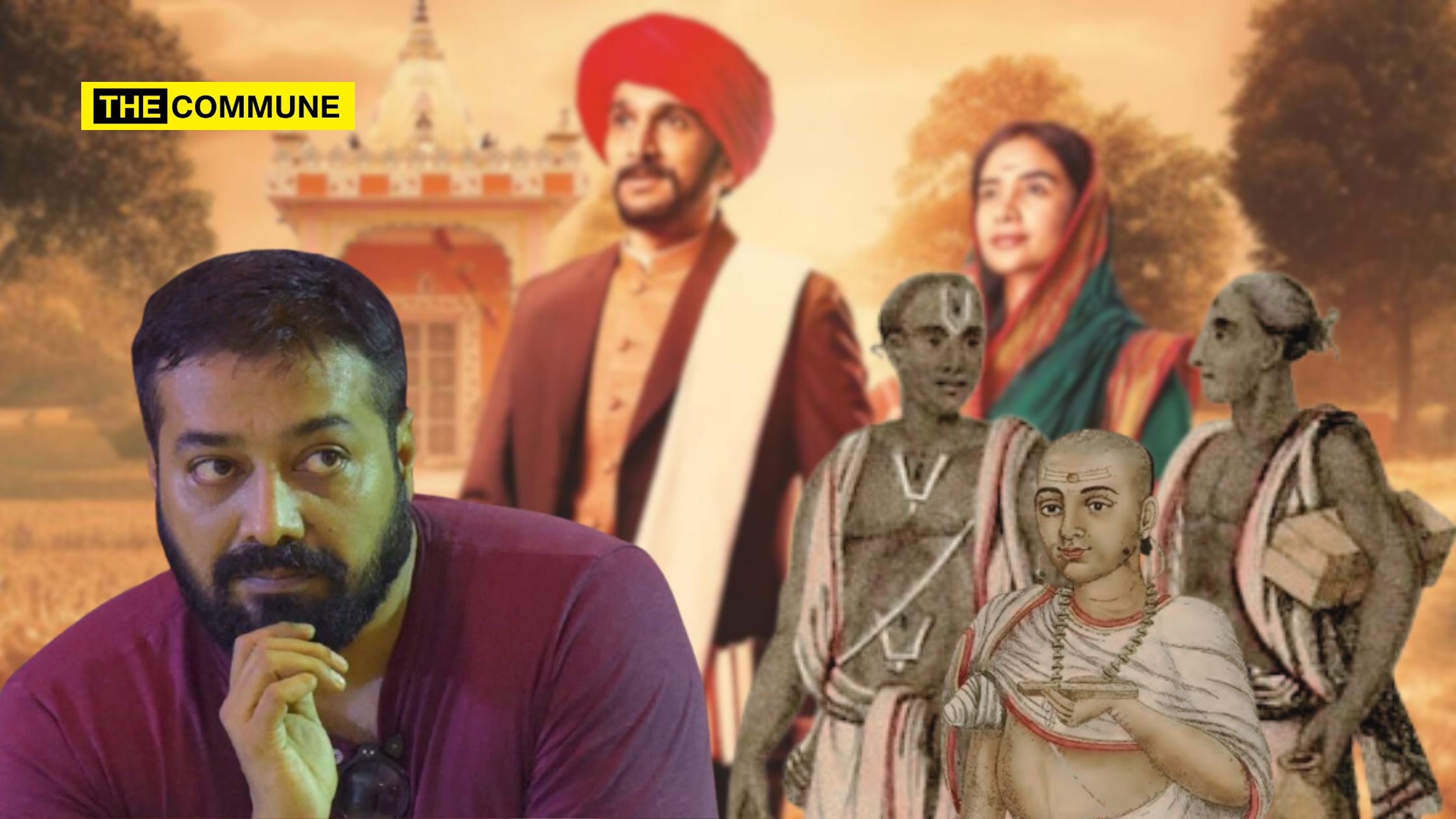
The shameless Bollywood director Anurag Kashyap, who has openly expressed hostility toward the Hindu Brahmin community, has offered a half-hearted apology after facing backlash for his remark about urinating on Brahmins. In response to the outrage, he claimed the statement was taken out of context, though it appeared to stem from a long-standing resentment he harbors against the community.
In a recent Instagram post, Kashyap attempted damage control by writing, “This is my apology, not for my post but for that one line taken out of context and the brewing hatred.” He also said that due to the backlash, his daughter, relatives, and friends were receiving threats. His apology, however, was far from sincere. Kashyap himself admitted that if an apology was expected, then that would be it—an evidently reluctant and dismissive statement.
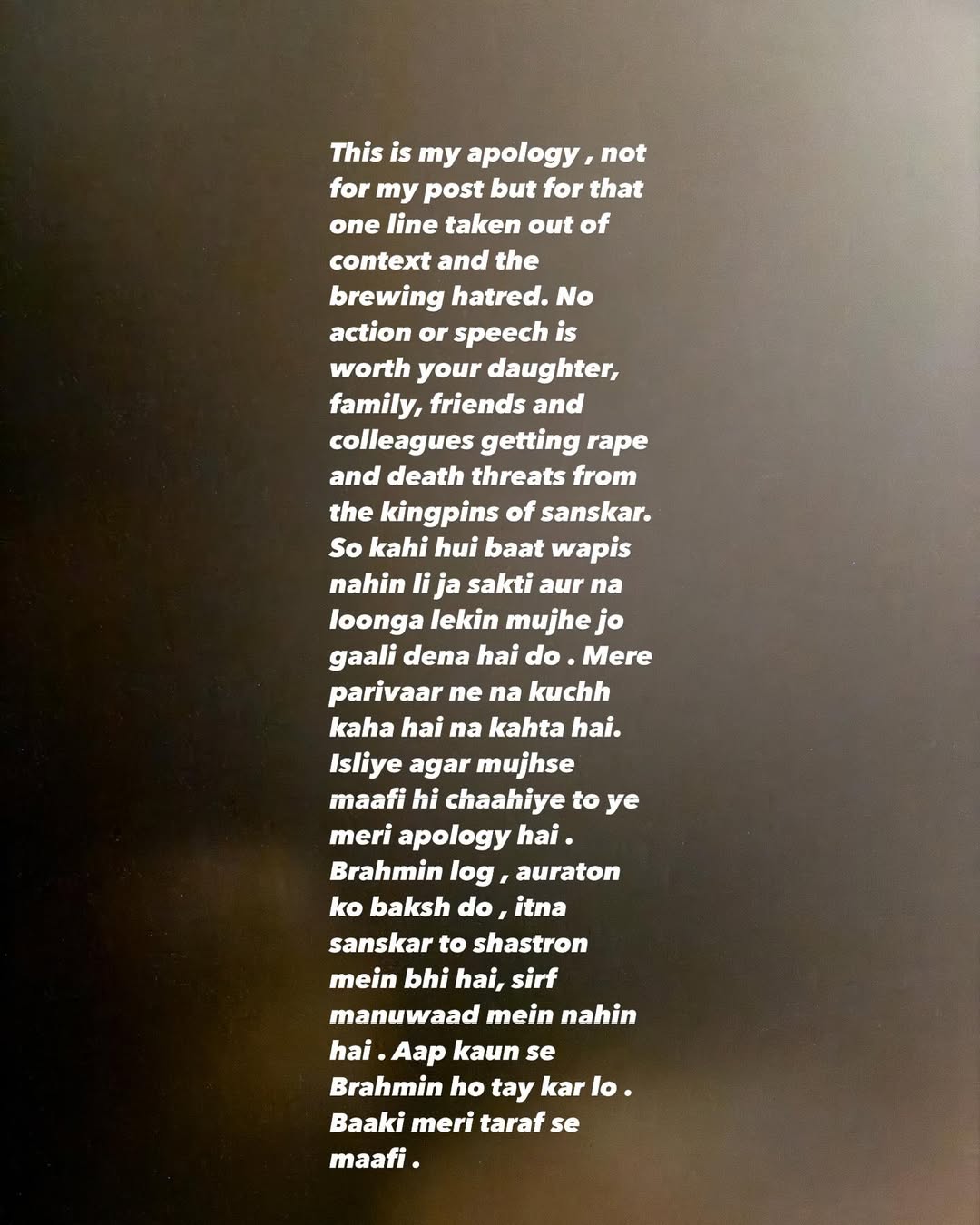
View this post on Instagram
The controversy erupted on 17 April 2025, after Kashyap took to Instagram to vent his frustration about the delay in releasing Phule, a film directed by Ananth Mahadevan and featuring Prateek Gandhi and Patralekha as Jyotiba and Savitribai Phule. The delay, reportedly influenced by objections from some Maharashtrian Brahmin groups, led to a heated rant by the filmmaker.
In his Instagram story, Kashyap recounted that his first theatrical performance was based on Jyotiba and Savitribai Phule. He criticized caste-based inequality in India and questioned why Brahmins were offended by a film addressing such issues. His language was laced with expletives and contempt, accusing Brahmin communities of either being ashamed or living in denial about casteism in the country.
He further lambasted the film certification process, questioning how certain groups managed to access unreleased films. Kashyap accused the system of being corrupt and said that films addressing uncomfortable social realities, such as Punjab 95 and Dhadak 2, often faced unwarranted censorship. He claimed the government was too ashamed to face its own reflection and lacked the courage to confront the issues these films expose.
In a long instagram story, Kashyap wrote, “Meri zindagi ka pehla natak Jyotiba aur Savitribai Phule pe tha. Bhai agar casteism nahin hota is desh mein toh unko kya zaroorat thi ladne ki. Ab ye Brahmin log ko sharam aa rahi hai ya wo sharam mein mare ja rahe hain ya phir ek alag Brahmin Bharat mein jee rahe hain jo hum dekh nahin paa rahe hain, ch****a kaun hai koi to samjhave. (The first play I ever did in my life was on Jyotiba and Savitribai Phule. If casteism didn’t exist in this country, why would they have needed to fight against it? Now these Brahmin groups either feel ashamed, are dying of shame, or perhaps they’re living in some alternate Brahmin-only India that we’re unable to see. Someone please explain—who’s the real fool here? My question is, when the film goes for censoring, there are four members in the board. How the f**k the groups and the wings get access to films until and unless they are given access to it? The whole f**king system is rigged.”
He also lamented that, “I don’t know how many other films are blocked that exposes the agenda of this casteist, regionalist, racist government… so ashamed to see their own face in the mirror. So ashamed that they can’t even openly talk about what it is about the film that bothers them. f**king cowards.”
He also made a post on his Instagram where he wrote, “During the screening of Dhadak 2, censor board told us that Modiji has eradicated the caste system in India. On the same grounds, Santosh couldn’t be released in India either. Now, Brahmins are objecting to Phule. Brother, if there’s no caste system, how can you be a Brahmin? Who are you? Why are you getting worked up?” he questioned.
View this post on Instagram
In a particularly aggressive response to a commenter who referred to Brahmins as Kashyap’s forebears, the director allegedly replied, “I’ll urinate on Brahmins… got a problem?” This crude and offensive comment has been widely condemned as hate speech and reflective of deep-seated hostility toward the Brahmin community.
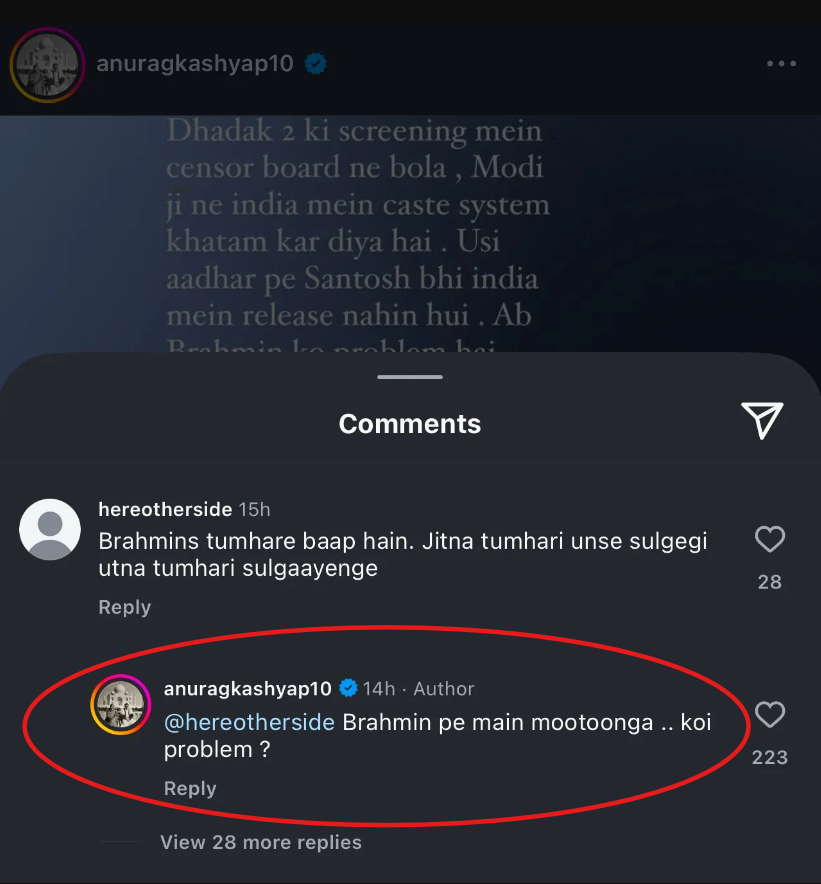
(Image Credits: OpIndia)
Critics argue that Kashyap’s rhetoric goes beyond artistic dissent and veers into open hostility. Rather than fostering constructive dialogue on caste issues, his statements are seen as vilifying an entire community, reinforcing harmful stereotypes, and encouraging hatred. The film Phule itself, based on its trailer, is seen by some as offering a one-sided portrayal, casting Brahmins as the sole antagonists while ignoring their historical contributions to reform and education.
Moreover, Kashyap’s criticism of the BJP government—calling it casteist, regionalist, and racist—seemed to draw a line between present political ideologies and historical social issues, conflating the two to support his narrative. He questioned how a Brahmin identity can exist if casteism has supposedly been eradicated, citing a censor board comment claiming Prime Minister Modi had ended caste-based divisions in India.
The Bad Girl Connection
This isn’t the first time Anurag Kashyap has faced allegations of harboring anti-Hindu sentiments. Back in 2017, after filmmaker Sanjay Leela Bhansali was assaulted during the filming of Padmavat, Kashyap referred to the attackers as “Hindu terrorists.” Yet, he has remained conspicuously silent when it comes to religious extremism from other communities. But did his anti-Brahmin rhetoric end there? Not at all. The shameless director has continued to spread his animosity through different platforms. Most recently, he co-produced Bad Girl, a film by Vetri Maaran—another filmmaker who pushes Communism and anti-Brahmin agenda. The movie, like much of their work, seems to single out Brahmins as the sole villains. How convenient for these so-called ‘social justice warriors’ to mask targeted hate as progressive cinema.
Some observers have pointed out that criticism of Brahmins has increasingly become mainstream, particularly in Maharashtra, where Brahmins are often portrayed negatively despite being a minority. The history of anti-Brahmin sentiment in the state includes violent incidents like the 1948 Chitpavan Brahmin attacks and more recent social media-driven hate campaigns. Critics believe this pattern continues in modern cinema and political discourse, contributing to an environment where Brahmins are vilified for historical injustices they had no part in.
This pattern of targeting Brahmins isn’t limited to Maharashtra. In Tamil Nadu, Brahmins have faced hostility dating back to the mid-20th century, including symbolic acts like cutting the sacred thread (poonool). Political parties such as the DMK have made strong anti-Sanatana Dharma statements, which many interpret as veiled attacks on Brahminical traditions.
Despite being a relatively small community, Brahmins are increasingly subject to ridicule, stereotyping, and reverse discrimination. Their cultural identity, including practices such as vegetarianism and wearing the Janeu, is frequently mocked under the guise of progressive criticism.
A Marxist-Historian Myth Debunked Time and Again
Is what they preach against Brahmins actually true, or is it just a repetition of long-debunked narratives driven by bias and historical distortion? It’s exhausting to keep dismantling the same Marxist historian myths that have already been exposed over and over again. What’s ironic is that they likely know the truth themselves—but they continue to recycle colonial-era distortions, especially those pushed by the British to enforce their “Divide and Rule” policy.
One of the most compelling rebuttals to these falsehoods comes from the Gandhian thinker, historian, and political philosopher Dharampal. In his seminal work, The Beautiful Tree: Indigenous Indian Education in the Eighteenth Century, Dharampal meticulously studied original records from British colonial archives—surveys commissioned by the East India Company and preserved across the UK. His decade-long research uncovered a reality that flies in the face of the Brahmin-villain narrative.
His findings documented a vibrant and inclusive indigenous education system across the Madras and Bengal Presidencies and Punjab, with a curriculum that was far more advanced and accessible than what is commonly portrayed. In fact, nearly 30% of children aged 6–15 attended school daily. Surprisingly to many, students from so-called “lower” castes—including Shudras and those considered below them—made up a significant portion of the student body. In places like Kerala, even Muslim girls were well-represented in these institutions.
Anurag Kashyap’s claim that “Brahmins didn’t allow others to study” is flatly contradicted by this evidence. Data from the Madras Presidency and Bihar clearly shows that the majority of students were from non-Brahmin castes. The British records even show that Brahmins were a minority in many schools. While they did dominate fields like theology and law—understandably so, given those were areas of traditional scholarly focus—subjects like astronomy and medicine were studied and practiced by individuals from various communities. For example, in Malabar, out of 808 students learning astronomy, only 78 were Brahmins; similarly, out of 194 studying medicine, only 31 were Brahmins. Even barbers were recognized by British officials as the most skilled surgeons of the time.
https://twitter.com/vedant_bangad/status/1913224705990939127
This data dismantles the idea that Brahmins monopolized knowledge or oppressed others by restricting access to education. Yet, despite overwhelming evidence, people like Kashyap continue to push the same tired narratives, now repackaged through films and pop culture. And why? Because keeping Brahmins in a perpetual negative light is a lucrative formula—it sells outrage, attracts funding, and fuels a political agenda. It’s no coincidence that Kashyap co-produced Bad Girl by Vetri Maaran—another director often accused of peddling anti-Brahmin, far-left Communist rhetoric.
It seems the goal isn’t social justice but targeted vilification—distorting history, silencing nuance, and demonizing an entire community for profit and ideological gain.
In conclusion, Anurag Kashyap’s recent tirade is seen by many as less about advocating for social reform and more about perpetuating a hostile narrative against Brahmins. While caste-based inequality is a reality that must be addressed, critics argue that vilifying an entire community in the name of progress only deepens divisions. Kashyap’s language and attitude, especially his comment about urinating on Brahmins, have turned what could have been a meaningful discussion into an ugly and divisive controversy.
(With inputs from OpIndia)
Subscribe to our channels on Telegram, WhatsApp, and Instagram and get the best stories of the day delivered to you personally.