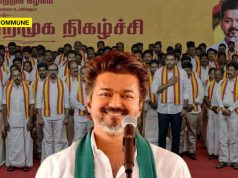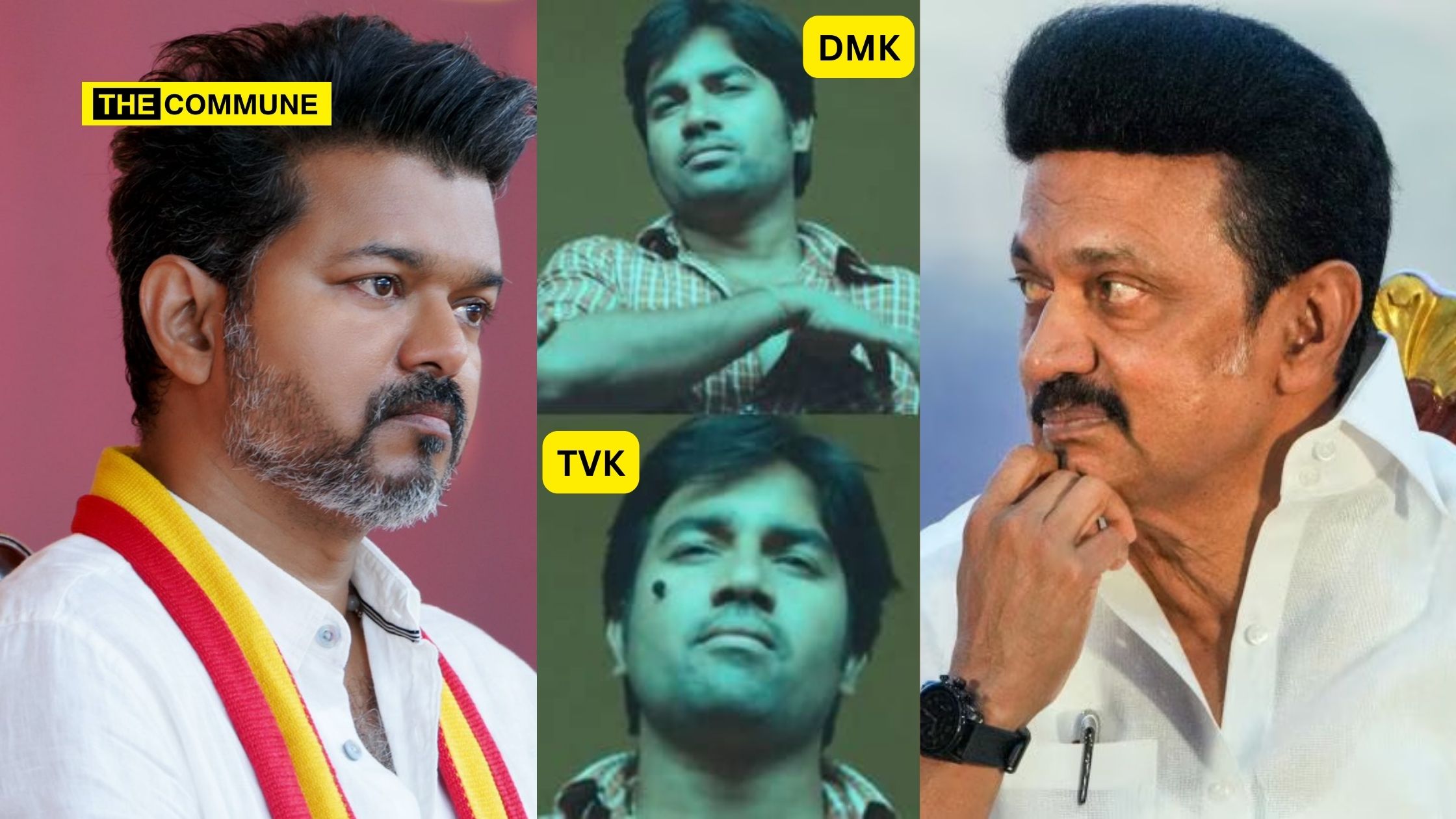
Much like the grand promotions of star-studded films that lack substance and are destined to flop, part-time-politician Vijay successfully conducted his first-ever general council meeting of the Tamilaga Vettri Kazhagam (TVK)—only to deliver nothing new to his party cadres, once again repackaging old ideas in a new bottle.
The general council meeting, held on 28 March 2025, in Thiruvanmiyur, Chennai, has further reinforced the notion that Vijay is not a political threat to the ruling DMK but rather aligns with its goals. His resolutions largely reflect DMK’s existing agenda, positioning him more as a mirror to the ruling party rather than an independent force in Tamil Nadu politics.
A closer look at these resolutions reveals a clear pattern—Vijay’s TVK only takes stands that align with DMK’s interests. This trend was also evident on 3 November 2024, when TVK’s official resolutions after its first state-level conference reflected similar positions. It raises questions about whether Vijay’s political entry is truly independent or merely a extension of DMK’s political wing.
At Tamilaga Vettri Kazhagam’s (TVK) general council meeting, 15 resolutions were passed, covering a range of issues, including:
- Opposition to the Waqf Bill
- Rejection of the Parandur Airport project
- Support for fishermen’s rights
- Endorsement of the two-language policy
- Opposition to delimitation
- Advocacy for state autonomy
- Women’s safety reforms
- Support for JACTO-GEO (government employees’ rights)
- Criticism of the state’s law and order situation
- Justice in the TASMAC scam
- Caste survey implementation
- Justice for Sri Lankan Tamils
- Renaming an international convention center after Periyar
- Encouraging cadres to follow party ideologues
- Granting full authority to the party leader
- Official recognition of TVK members
- Obituary notices for TVK members
தமிழக வெற்றிக் கழகத்தின் பொதுக்குழுக் கூட்டம்
தீர்மானம் 1 : இஸ்லாமியர்களின் உரிமைகளை பறிக்கும் WaqF மசோதவை ஒன்றிய அரசு திரும்ப பெற வேண்டும்
தீர்மானம் 2 : மீனவர் போராட்டதுக்கு ஆதரவு மற்றும் அவர்களின் பிரச்சினைகளுக்கு நிரந்தர தீர்வு எட்டப்பட வேண்டும்
தீர்மானம் 3 : பரந்தூரில்… pic.twitter.com/PDvWKPKz8B
— Actor Vijay Fans (@Actor_Vijay) March 28, 2025
A closer look at these resolutions reveals a strategic alignment with the ruling DMK’s current political stance. Key resolutions, such as opposition to the Waqf Bill, support for fishermen’s rights, endorsement of the two-language policy, opposition to delimitation, and advocacy for state autonomy, are all core issues that DMK is using to counter the BJP-led central government. Vijay, who has publicly declared DMK as the only real opposition to the TVK, seems to be merely echoing the ruling party’s narrative and promoting it.
Another interesting observation is TVK’s stance on rejecting the Parandur Airport project and supporting JACTO-GEO, which have traditionally been DMK’s brownie points whenever they were in opposition. By endorsing these positions, is Vijay attempting to secure votes that would otherwise drift away from DMK, ensuring that they do not shift toward alternative opposition parties like BJP, NTK, or others? This raises a larger question about whether TVK is truly independent or strategically positioned to prevent a split in DMK’s voter base.
Both Opposing the Waqf Bill
Since the announcement of the Waqf Amendment Bill, both the DMK and its political extended arm, TVK, have strongly opposed it, resorting to fearmongering tactics within the Muslim community, much like they did during the CAA-NRC debates. They have claimed that the bill would significantly harm Muslims—a narrative similar to the one they pushed against the CAA, where they alleged that Indian Muslims would lose their citizenship. However, despite the implementation of CAA, no Indian Muslim lost their citizenship, proving that the fear-driven claims were misleading.
This time, in the Waqf issue DMK escalated its opposition further by passing a resolution in the Tamil Nadu Assembly on 27 March, urging the central government to withdraw the bill. Chief Minister M.K. Stalin defended the move, stating that the bill would “badly affect minority Muslims,” contrary to the real intention which passed by the JPC committee of the parliament.
Mirroring the DMK’s stance, TVK also made the opposition to the Waqf Amendment Bill its top priority, officially passing a resolution against it in its recent general council meeting. It is worth noting that this issue was given top priority in TVK’s resolution following its first state-level conference also. With TVK following DMK’s lead, raises the question—is this genuine opposition, or a strategic political move to secure minority votes while preventing them from shifting to the opposition?
Supporting Fishermen’s Rights
Part-time politician Vijay previously had no stance on the Tamil Nadu fishermen’s issue, nor was it included in his party’s resolutions after their first conference. However, all of a sudden, it was given prominence in the recent general council meeting. The timing raises questions, as just recently, on 7 February 2025, Members of Parliament from the DMK and its alliance partners staged a protest in the Parliament premises, condemning the repeated arrests of Tamil Nadu fishermen by the Sri Lankan Navy and pressuring the central government for a permanent solution. With no other major issues to create disruption in Parliament, they seized on this matter to stir controversy.
Now, Vijay has conveniently echoed the same stance, jumping on the bandwagon and aligning his party’s resolution with the DMK’s narrative. This is yet another classic example of how Vijay continually simps the DMK’s agenda, seemingly desperate for their attention.
Two-language policy
Vijay has strongly opposed the three-language policy, despite his own son, Jason Sanjay, studying at the American International School in Chennai, where languages like French, Spanish, and Korean are offered alongside English. In some IB schools, students also have the option to choose Hindi. The rationale behind the three-language policy is to provide marginalized students— even many of whom currently lack access to government schools—a chance to learn a third language. This would enable them to pursue careers as translators, communicators, and open doors to international job opportunities.
However, Vijay, along with other Dravidian leaders and the DMK, oppose marginalized students to venture beyond Tamil Nadu. They seem to believe these students should remain confined to the state, study locally, and take on menial jobs, ultimately serving as a political vote base through emotional appeals. The hypocrisy lies in the fact that this “two-language policy” exception doesn’t apply to Matriculation, CBSE, or international boards, which offer a wider array of language options. Yet, Vijay appears intent on following this same narrow-minded stance.
Even more surprisingly, just like DMK leaders and their allies who own CBSE schools that promote multilingual education, Vijay’s own CBSE school, Vijay Vidyashram, proudly boasts and celebrate Hindi—the very language they publicly oppose.
Both Opposed Parandur Greenfield Airport Plainly
Vijay, during his visit to Parandur, alleged that the proposed airport would destroy 90% of farmland and 13 water bodies, calling the project “anti-people.“ He also questioned why the DMK, which had opposed projects like the Salem eight-lane expressway and Kattupalli port, was supporting the Parandur airport. However, a closer look at the Airports Authority of India (AAI) pre-feasibility report and the Tamil Nadu government’s decision-making process reveals that Vijay’s statements are either misleading or based on incomplete information.
The Airports Authority of India (AAI) conducted a detailed study to identify the most suitable site for Chennai’s second airport, considering locations like Padalam, Thiruporur, Pannur, and Parandur. Parandur emerged as the best option due to factors such as airspace restrictions at other sites, availability of 5,369 acres of land, better connectivity through the Chennai-Bengaluru Expressway, and fewer displacements compared to Pannur. Additionally, Parandur offers significant potential for future development, unlike the more densely developed Pannur site. Vijay’s claims about the project destroying 90% of farmland and 13 water bodies lack substantiation and overlook the thorough environmental and social impact analysis in the AAI report. Critics suggest that Vijay’s opposition to the project is driven by political motives, with his visit to the protest site viewed as a publicity stunt. Aviation experts argue that Parandur is the most feasible site for the airport, and relocating the project would cause delays and increased costs.
A similar approach was taken by the DMK in 2019 when it criticized the AIADMK government while in the opposition, but once it came to power, the party acknowledged the airport as a crucial need for the state’s economy.
Opposition to Delimitation & Advocacy for State Autonomy
Delimitation became the DMK’s last resort after their previous political maneuvers failed. When their attempt to stir up protests over the so-called ‘Tamil language imposition’ flopped—mainly because of their own hypocrisy in running CBSE schools that teach the very Hindi they claim to oppose—they quickly shifted focus. Realizing they weren’t getting the public support they had hoped for, they suddenly latched onto delimitation, a topic that wasn’t even relevant. They aggressively pushed their narrative, staged political stunts, called for a joint meeting of Southern Chief Ministers, and passed resolutions to gain traction.
TVK chief Vijay, often labeled the ‘B-Team of the DMK’, appeared offended by that tag. In response, he opposed delimitation, but in an ironically absurd twist, he also claimed there was no need for it at all. This stance was both shocking and laughable—without proper representation in Parliament, how does he plan to voice the people’s concerns or secure funds for Tamil Nadu’s welfare? His move was nothing more than a slightly altered version of the DMK’s stance, but executed so poorly that he ended up making a mockery of himself.
The ultimate irony? While Vijay opposing delimitation and the increase of MP seats, he simultaneously demanding state autonomy in his latest resolution. This contradiction exposes a lack of clear vision—either he should fight for representation and resources or completely reject the process. But switching between “no need for delimitation” and then immediately demanding more autonomy makes it seem like he doesn’t even understand his own political positions.
Subscribe to our channels on Telegram, WhatsApp, and Instagram and get the best stories of the day delivered to you personally.