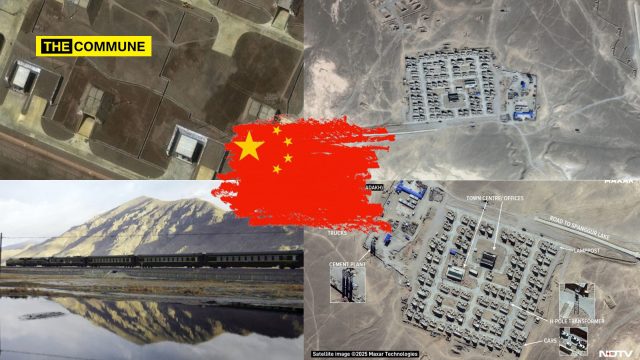
Image Source: NDTV & India Today
Over the past four years, China has intensified infrastructure development along its frontier with India, accelerating road, rail, energy, and military-linked projects close to sensitive sectors of Arunachal Pradesh, Sikkim, and Ladakh. Satellite imagery and official assessments indicate a steady buildup of dual-use facilities capable of supporting both civilian and defence operations. Analysts warn that while these projects are officially labelled as development initiatives, their proximity to the Line of Actual Control (LAC) presents new operational challenges for India’s security apparatus. Below is a detailed account of nine key Chinese projects completed or initiated between 2021 and 2025 that have drawn attention in New Delhi.
#1 China Builds Air-Defence Complex Near Pangong Lake – 24 October 2025 | Location: Pangong Lake, Tibet
Satellite imagery revealed a newly constructed Chinese air-defence complex near Pangong Lake, roughly 110 kilometres from Doklam. The facility comprises radar stations, command centres, missile launch units, and retractable shelters believed to house HQ-9 long-range surface-to-air missiles. The installation, equipped with advanced radar coverage and munitions depots, enhances China’s ability to monitor and target Indian aircraft across Ladakh and Nyoma. Defence analysts warn that the complex gives Beijing a sharper air-defence edge, reducing India’s freedom of manoeuvre in the region.
#2 China Mirrors Pangong Base Opposite Nyoma Airfield – September 2025 | Location: Gar County, Tibet
A replica of the Pangong air-defence facility has been identified at Gar County, just 65 kilometres from the LAC, opposite India’s upgraded Nyoma airfield. The Nyoma airstrip, at 13,710 feet, is being expanded by the Border Roads Organisation at a cost of ₹230 crore to support fighter and heavy transport aircraft. Experts believe the mirrored site enables coordinated radar and missile coverage against Indian air activity. The proximity of both bases could give China an advantage in airspace monitoring and quick strike capability across eastern Ladakh. (Sources: Firstpost, Moneycontrol)
#3 36 Hardened Shelters Built at Lhunze Airbase Near Arunachal – 17 October 2025 | Location: Lhunze Airbase, Tibet
New satellite images from 17 October 2025 confirmed the construction of 36 hardened aircraft shelters at Lhunze Airbase, roughly 100 kilometres from Tawang in Arunachal Pradesh. The expansion also includes new aprons and administrative buildings. Military experts warn this infrastructure allows forward deployment of fighter jets and armed drones, cutting Chinese response times along the McMahon Line. Former IAF chief B.S. Dhanoa stated the hardened shelters remove prior vulnerabilities of China’s high-altitude bases, signalling sustained readiness for future contingencies. (Source: NDTV)
#4 Pangong Tso Bridge Operational, Boosts PLA Mobility – 30 July 2024 | Location: Pangong Tso, Tibet
China completed and operationalised a 400-metre bridge across Pangong Tso in eastern Ladakh, connecting the lake’s north and south banks. The bridge has cut troop and tank movement time from 12 hours to about 4, greatly improving the PLA’s logistical agility. India criticised the project as illegal, noting that the Pangong area is disputed, with both countries maintaining overlapping claims. The bridge strengthens China’s ability to reinforce troops quickly in the event of a standoff, altering the tactical dynamics established since the 2020 clashes.
#5 PLA Builds Forward Headquarters at Sirjap – 2021–2022 | Location: Sirjap, Pangong Lake, Tibet
Between 2021 and 2022, China constructed a large military base at Sirjap, situated five kilometres from the LAC on the northern shore of Pangong Lake. The site, previously uninhabited, now functions as a forward headquarters for PLA troops in the region, integrating command and logistics facilities. The base consolidates Beijing’s permanent military presence and supports sustained operations around the lake. Defence analysts interpret this as part of China’s post-Galwan strategy to institutionalise troop deployment near friction points. (Source: Firstpost)
#6 New Chinese Settlement of 91 Buildings Near Pangong Lake – March 2024 – January 2025 | Location: South Bank, Pangong Lake
Satellite imagery captured between March 2024 and January 2025 shows China’s construction of a settlement with 91 permanent, weather-proof structures near Spanggur Lake, roughly seven kilometres east of the LAC. Experts describe the site as a dual-use settlement that can accommodate both civilians and troops, with roads, power transformers, and modern amenities. The rapid construction suggests intent for long-term habitation and enhanced surveillance of the Pangong–Spanggur corridor, altering pre-2020 ground realities. (Source: NDTV)
#7 Administrative Hub and Cement Plant Emerge in Pangong Region – 2024–2025 | Location: Northeast Bank, Spanggur Lake
New imagery from 2024–2025 reveals that China has developed administrative and industrial infrastructure within its Pangong settlement. Facilities include a cement plant and a communication tower, signalling continued expansion and consolidation. Defence analysts believe the new buildings serve administrative coordination and possibly logistical support for military units stationed nearby. The establishment of such infrastructure indicates China’s intent to sustain long-term operations and civilian presence in the area, embedding its hold near the contested frontier. (Source: NDTV)
#8 Construction of Xinjiang–Tibet Railway Near Ladakh Border – April 2025 | Location: Xinjiang–Tibet Region
In August 2025, China began constructing the 1,700-kilometre Hotan–Shigatse section of the Xinjiang–Tibet Railway, valued at $13.2 billion. The line parallels the G219 highway and passes close to the Indian border, connecting Aksai Chin to Tibet. Once completed, it will enable rapid military and logistics transport between western and southern Tibet. Indian analysts view the project as a strategic move to enhance China’s supply lines and mobility across high-altitude terrain. The line’s route through permafrost zones also raises ecological and engineering concerns.
#9 China Begins Building World’s Largest Dam on Yarlung Tsangpo – April 2025 | Location: Medog County, Tibet Autonomous Region
China has initiated construction of a mega hydroelectric project on the Yarlung Tsangpo (Brahmaputra River) in Medog County, near the Indian border. Estimated at $170 billion, the dam is expected to generate 300 billion kilowatt-hours of electricity annually—equivalent to the UK’s total consumption. India and Bangladesh have raised strong objections, citing risks to downstream water flow, agriculture, and potential weaponisation of water during conflict. Lawmakers in India have termed it a potential “water bomb,” warning of catastrophic flood risks in Arunachal Pradesh and Assam. (Source: Economic Times)
Subscribe to our channels on WhatsApp, Telegram, Instagram and YouTube to get the best stories of the day delivered to you personally.