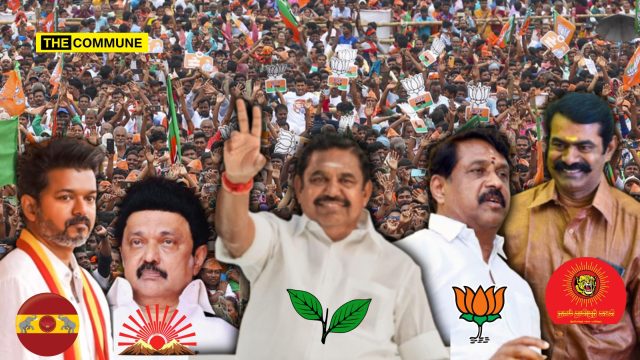
A detailed discussion aired on Tamil Janam 360, drawing on a large-scale opinion survey conducted by Poll Matrix India, offered a rare, layered look into voter sentiment ahead of the 2026 Tamil Nadu Assembly elections. Based on a reported sample of approximately 7,400 respondents surveyed from late October 2025 onwards, the survey and subsequent discussion moved beyond headline seat projections to expose deeper contradictions in governance perception, media narratives, alliance mathematics, and the growing role of cinema-driven political identity.
Rather than presenting a simple forecast, the findings revealed fault lines that may ultimately determine the election’s outcome: recall versus reality, perception versus performance, and arithmetic versus ideology.
The DMK Government’s “Report Card”: Recall Over Governance
The survey assigns the ruling Dravida Munnetra Kazhagam government an overall administrative score of approximately 6.37, indicating above-average performance but falling short of strong approval. Crucially, it was clarified that this score was not derived from direct evaluation of governance but from indirect perception-based responses.
A major contradiction emerged in public recall. When respondents were asked to identify key government achievements, memory overwhelmingly converged on just two welfare schemes – Free bus travel for women and the ₹1,000 monthly cash assistance scheme.
More than 500 electoral promises including those made to government employees, teachers, nurses, sanitation workers, and other frontline staff barely registered in public memory.
The survey emphasised that this gap does not necessarily indicate effective governance but rather media-driven recall bias. Schemes that receive sustained publicity are remembered; those quietly stalled, diluted, or delayed fade from collective consciousness. Areas such as law and order, drug trafficking, flood management, sanitation, and treatment of frontline workers are core governance indicators but were not foregrounded in the survey’s design.
Anti-Incumbency: Suppressed, Not Absent
While the overall score suggests surface-level stability, analysts converged on a key assessment: anti-incumbency exists, but remains delayed.
The findings seem to identify a “silent anger” that has not yet translated into visible political expression. This suppression is attributed to:
- Continuous welfare distributions
- Controlled media narratives
- Limited scrutiny of governance failures
It is possible that this latent dissatisfaction could surface after Pongal, when:
- Free distributions slow down
- New policy announcements taper off
- Price pressures related to power tariffs, milk prices, education fees, and services become unavoidable
The absence of visible protest, they argued, reflects weakened media scrutiny rather than public contentment.
Leadership Ratings: Visibility As A Proxy For Performance
Chief Minister – M. K. Stalin
Stalin’s leadership scores clustered high across perception-based metrics:
- Administration: 7.2
- Public image: 7.0
- People connect: 8.0
- Infrastructure: 6.8
It is possible that these scores align closely with visibility rather than outcomes. Carefully curated walkabouts, controlled public interactions, and selective media amplification can be factors inflating the “people connect” metric, that could have been modelled on high-visibility national political campaigns.
Opposition Leader – Edappadi K. Palaniswami
Palaniswami scored higher in administration and infrastructure, reflecting retrospective reassessment of his tenure. Despite years of hostile media coverage while in office, his governance record particularly in organisational stability and infrastructure execution has gained renewed recognition.
His lower visibility score can be attributed to weaker media amplification rather than organisational weakness. The findings seem to highlight his continued grip over party machinery, especially in western Tamil Nadu, as a critical electoral asset.
The Vijay Factor: Media-Manufactured Momentum
The entry of Vijay and his party TVK emerged as one of the most revealing aspects of the analysis.
Vijay’s administrative score of around 5 may be openly acknowledged as entirely fictional, shaped not by political experience but by cinematic roles in films such as Sarkar, Kaththi, and Thalaivaa. Despite this, his “people connect” score soared driven by relentless television and digital exposure.
A striking finding was that many respondents rated Vijay on governance metrics despite being unable to define governance itself.
Most crucially, one can conclude that Vijay’s vote base may not be neutral. His support draws disproportionately from DMK’s traditional ally vote banks, particularly in urban and coastal pockets such as Chennai and Kanyakumari, rather than from AIADMK or BJP voters. In effect, TVK functions as a DMK vote-splitter, not a third force equally damaging to both sides.
Seeman And NTK: Visibility Without Conversion
Seeman and NTK can be described as highly visible but electorally inefficient. While Seeman scores strongly on rhetoric and digital presence, this visibility has not translated into seat-level success.
The survey points to weak booth-level machinery, limited alliance expansion, and vote share stagnation.
NTK’s realistic electoral footprint remains limited to one or two seats at best, with its influence largely confined to digital and protest spaces.
Alliance Arithmetic: Where Elections Are Won
A central theme of the survey was vote transfer efficiency, identified as more decisive than ideology.
- DMK–Congress: ~92%
- DMK–VCK: ~94%
- AIADMK–BJP: historically ~65%, projected to rise to 70–75%
It is an open secret that AIADMK and BJP need each other structurally. Ideological discomfort is secondary to arithmetic necessity.
Regional Breakdown
Western Tamil Nadu (Kongu belt): Strong NDA advantage due to caste consolidation and organisational depth
Northern Tamil Nadu: NDA leads, aided by PMK influence, though internal frictions remain
Delta region: DMK dominance driven by SC and minority consolidation
Southern Tamil Nadu: Highly fragmented, with religion and caste acting as decisive variables
Chennai: DMK stronghold, but erosion visible due to TVK’s urban appeal
Media As The Central Variable
The most consequential argument that can be identified from the survey was that media behaviour, not opposition strength, is DMK’s biggest vulnerability.
It is noteworthy that EPS faced sustained media hostility during his tenure, Stalin has benefited from consistent media shielding and the Dravidianist media selectively underreported protests, violence, and governance failures.
This imbalance has triggered a credibility collapse, pushing politically engaged audiences toward alternative platforms such as Tamil Janam.
Final Projection: Toward A Hung Assembly
Poll Matrix’s own projections suggest:
- No party is likely to cross the 117-seat majority mark independently
- A coalition government is the most probable outcome
- The NDA has a marginally higher probability of forming government than the DMK alliance, but without certainty
A hung assembly with post-poll negotiations emerged as the most realistic scenario.
Conclusion
The Poll Matrix survey inadvertently revealed a deeper transformation in Tamil Nadu politics. Electoral outcomes are no longer driven primarily by governance performance, but by perception engineering, media mediation, and vote fragmentation.
The 2026 Assembly election is shaping up not as a referendum on administration alone, but as a test of credibility of leaders, alliances, and the media itself. Whether the currently muted discontent translates into votes once welfare optics recede remains the unanswered question that will define the state’s political future.
Subscribe to our channels on Telegram, WhatsApp, and Instagram and get the best stories of the day delivered to you personally.