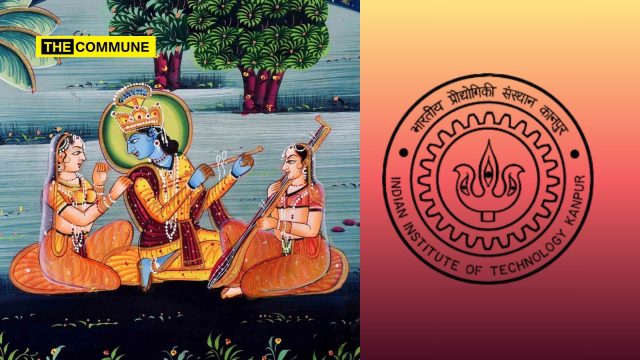
An academic paper authored by Dr. Rima Bhattacharya, a faculty member of the Department of Humanities and Social Sciences at the Indian Institute of Technology (IIT) Kharagpur, has triggered a wave of criticism on social media after excerpts from the study were circulated online this week. The paper, published in 2018 in the Indian Journal of Gender Studies (SAGE Publications), explores themes of gender and sexuality within Bhakti literature and interprets the emotional relationship between Radha and Mirabai through a “lesbian continuum” framework.
This research was done when Bhattacharya was with IIT Kanpur (as mentioned in the paper). It is unclear whether she is still with IIT Kharagpur or has moved to Christ University.
She did this while doing her research for IITK. She taught at IITKGP but now at Christ University
— Harshil (હર્ષિલ) (@MehHarshil) October 11, 2025
The article, titled “The Transgendered Devotee: Ambiguity of Gender in Devotional Poetry,” examines two prominent devotees of Lord Krishna, Mirabai and Surdas, and argues that early Bhakti poetry contains “instances of queer identity” which have been erased or overlooked in later interpretations. The author applies queer theory to explore gender fluidity and non-heteronormative expressions within Bhakti traditions, suggesting that devotional emotion often transcends fixed gender categories.
According to the abstract, the paper seeks to determine whether gender divisions remain constant or evolve with the emotional dynamics of Bhakti. It claims that both Mirabai and Surdas can be understood as “sexual subjects who are culturally dependent and historically specific.” The author writes that the study uses queer theory “to explore the contested categorisation of gender and sexuality,” asserting that identities are not fixed but composed of varying constituents.
A section of the paper that has sparked controversy online draws from literary interpretations of devotional poetry and states, “The bonding of Mira and Radha expressed in this poem may recall Adrienne Rich’s idea of a ‘lesbian continuum’ which includes a range of woman-identified experiences… not simply the fact that a woman has had or consciously desired sexual experience with another woman.”
The paper further notes that “Mira and Radha could be a part of this lesbian continuum,” interpreting their emotional and spiritual bond as an instance of woman-identified power and solidarity. It also references queer theorists such as Jonathan Dollimore and Alan Sinfield, describing non-heterosexual subcultures as “points at which alternative or oppositional ideologies may achieve plausibility.” The article argues that “sexual dissidence” may function as a political act capable of challenging dominant cultural norms.
In discussing the emotional dualities of sangam (union) and viraha (separation) in Bhakti poetry, the paper states that these states are “ideally felt and expressed in a poem towards a lover.” It equates the ecstasy of spiritual union with the joy of sexual union, suggesting that “the highest form of worship in the Bhakti cult is considered a mixture of the spiritual and the sensual.”
What the hell is happening in IIT-Kharagpur?!@dpradhanbjp @EduMinOfIndia @MinOfCultureGoI
A research paper in an academic journal has these lines –
👉🏼The bonding between Radha and Mira may recall the idea of “lesbian Continuum”
👉🏼Emerging relationship between Radha and… pic.twitter.com/xV0Cg656vw
— Monidipa Bose – Dey (মণিদীপা) (@monidipadey) October 11, 2025
The publication has drawn sharp criticism from several social media users, who have questioned the appropriateness of such interpretations in publicly funded institutions.
Some critics described the work as “academic perversion,” alleging that it reflected a “Western lens being imposed on Hindu sacred figures.” A number of users also compared the paper to earlier instances where religious themes were interpreted through modern gender or psychoanalytic frameworks, arguing that such studies were part of a broader pattern of “de-Hinduisation” within Indian academia.
The 2018 paper was published in Volume 25, Issue 2 of the Indian Journal of Gender Studies, a peer-reviewed journal of the Centre for Women’s Development Studies (CWDS). The journal is published by SAGE Publications.
So far, neither IIT Kharagpur nor Dr. Bhattacharya had issued a public statement in response to the controversy. The Ministry of Education has also not commented on the matter.
Subscribe to our channels on Telegram, WhatsApp, and Instagram and get the best stories of the day delivered to you personally.