


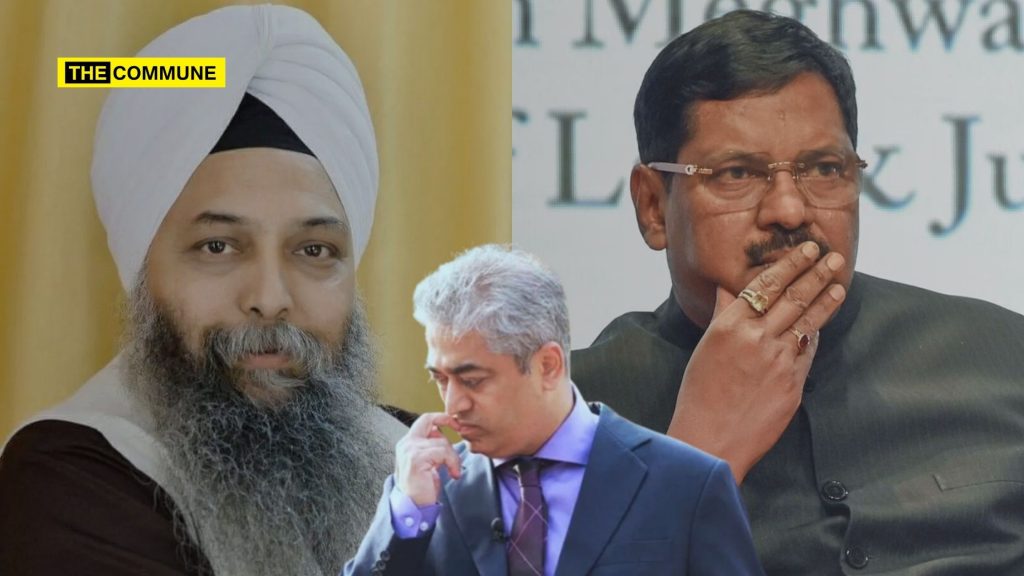
The recent shoe-throwing incident at Chief Justice of India Justice Gavai has once again exposed the glaring double standards in Indian journalism, particularly embodied by senior journalist Rajdeep Sardesai. His contrasting reactions to similar incidents separated by sixteen years reveal a pattern of selective outrage that aligns perfectly with political narratives rather than journalistic principles.
Shoe Throwing Attempt
Chief Justice of India (CJI) Bhushan R. Gavai on 6 October 2025 faced an attempted shoe-hurling incident in court but decided not to take any action against the lawyer involved, instead directing officials to “just ignore” the episode.
Reportedly, after security personnel intervened and escorted the lawyer out of the courtroom, officials sought the CJI’s instructions on the future course of action. “Just ignore,” the CJI told them, asking that the lawyer be warned and let go. The lawyer was later identified as Rakesh Kishore.
The dramatic scene unfolded during the mentioning of cases before the CJI’s Bench, when Kishore suddenly approached the dais and tried to take off his shoe. As he was being taken away, he was heard shouting: “Sanatan ka apman nahi sahenge (We will not tolerate any insult to Sanatan).”
The incident comes in the wake of a recent controversy over the CJI’s reported remarks during a hearing last month, when a Bench of CJI Gavai and Justice K. Vinod Chandran declined to entertain a plea filed by one Rakesh Dalal. Dalal had sought directions to restore a seven-foot beheaded idol of Lord Vishnu at the Javari temple, part of the Khajuraho group of monuments in Madhya Pradesh.
The petitioner had argued that the idol was mutilated during Mughal invasions and that authorities had failed to restore it despite repeated representations. The court held that the issue fell within the jurisdiction of the Archaeological Survey of India (ASI) and not the judiciary. During the hearing, the CJI reportedly told the petitioner’s lawyer: “Go ask the deity itself to do something now. You say you are a staunch devotee of Lord Vishnu. So go and pray now. It’s an archaeological site and ASI needs to give permission etc. Sorry.”
Rajdeep Sardesai’s Two Faces
Here’s how Rajdeep reacted to the two instances of shoe hurling.
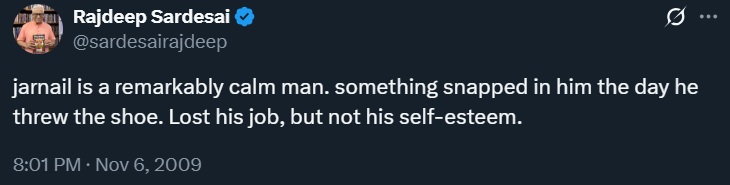
In 2009, when a Sikh journalist named Jarnail Singh hurled a shoe at then Home Minister P. Chidambaram in protest against the Congress government’s handling of the 1984 anti-Sikh riots, Sardesai’s response was one of empathy. He wrote, “Jarnail is a remarkably calm man. Something snapped in him the day he threw the shoe. Lost his job, but not his self-esteem.”
The tone was understanding, even sympathetic – a portrayal of moral outrage as human and perhaps justified.

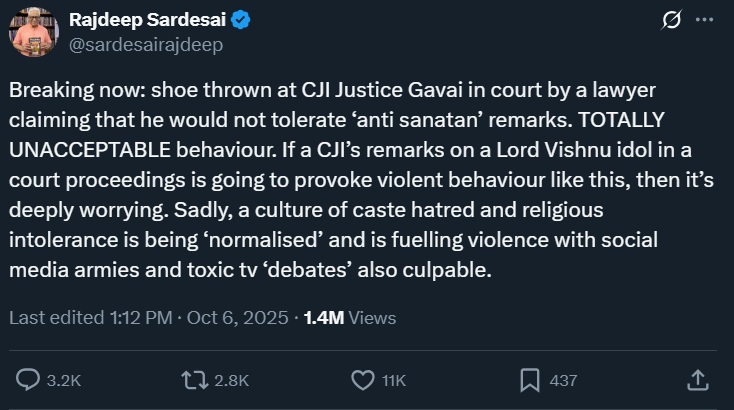
Fast forward to 2025. When a lawyer reportedly attempted to throw a shoe at Chief Justice of India Justice Gavai, claiming he would not tolerate “anti-Sanatan” remarks, Sardesai’s tone was the polar opposite. “TOTALLY UNACCEPTABLE behaviour,” he declared. He condemned the act as a symptom of “a culture of caste hatred and religious intolerance being normalised.”

So What Changed?
The difference in tone is striking. In one case, defiance was framed as a moment of personal conviction; in the other, it was branded as proof of religious extremism. Both men committed the same act – throwing a shoe at a powerful public figure – one attempted to throw. Yet one was treated as a man pushed to the edge by injustice, and the other as a dangerous emblem of intolerance.
What changed between 2009 and 2025? Not the act, but the political and ideological context surrounding it. Sardesai’s moral lens seems to shift with the target and the narrative. When the establishment was Congress-led and the protest came from a minority community, it was treated with empathy. When the establishment is judicial and the protest draws from a Hindu civilizational sentiment, it becomes “deeply worrying.”
Such selective outrage undermines journalistic credibility. The role of the press is not to rationalize one act of violence while condemning another, but to apply a consistent moral standard. The inconsistency here does not merely reflect bias; it shapes how society perceives dissent and legitimacy.
If shoe-throwing is wrong, and it should be, it is wrong regardless of the protester’s faith or the ideology invoked. A journalist’s credibility rests on that consistency.
Subscribe to our channels on Telegram, WhatsApp, and Instagram and get the best stories of the day delivered to you personally.