Chennai’s fragile civic infrastructure has once again been laid bare as the northeast monsoon brings heavy rain, exposing massive potholes, poor drainage, and long-neglected roads across key neighbourhoods in the south and north of the city.
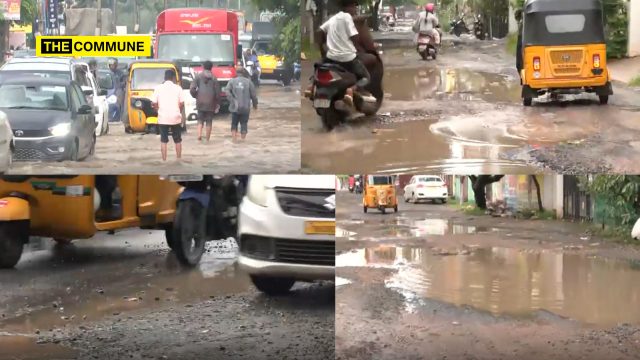
In Pallikaranai, Medavakkam, and Madipakkam, major residential and IT corridor zones, main roads have deteriorated into pothole-riddled stretches resembling a “lunar landscape.” A ground report by India Today showed the extent of damage, with reporter Anagha Keshav riding a scooter through Medavakkam to demonstrate how dangerous the commute has become. Residents said several of these stretches have remained in disrepair for years, despite repeated complaints. Many described the roads as “death traps,” with multiple accidents reported.
A reality check in Pallikaranai, the link between Velachery and Medavakkam, showed roads half-tarred and half-cobbled. Visuals from the area captured bikers and gig workers struggling to maintain balance over potholes, while autos and cabs attempted to navigate flooded lanes. Residents lamented that despite dry weather in the weeks before the rains, no repairs were made, leaving the roads to collapse under the first monsoon spells.
Velachery–Tambaram Road in Chaos After Botched Pothole Repairs
The Velachery–Tambaram road, a key four-lane commuter stretch, has become treacherous after state highways officials dumped cement to fill potholes, which washed away following heavy rain. Vehicle tyres got stuck, and some potholes reappeared, especially near Jayachandran Textiles, while other sections remained untreated.
Velachery-Tambaram Main Road in South Chennai pic.twitter.com/D96NF1AivA
— Omjasvin M D (@omjasvinMD) October 21, 2025
Commuters navigating the 15 km stretch were forced onto the non-stagnated lane, moving at just 10 kmph. Residents criticized the timing of repairs during rain, calling it a poor decision. Highways assistant engineer Murugan said bituminous patchwork is ongoing. Tambaram Corporation limits cover only part of the stretch, leaving coordination gaps with other departments.
The pothole-laden Velachery-Tambaram road was turned into a stretch of slush by the state highways officials overnight. How?
The highways officials dumped loads of cement on the road recently to fill the potholes. As rain followed shortly thereafter, the cement did not set… pic.twitter.com/YVWaHy3IPZ
— Omjasvin M D (@omjasvinMD) October 22, 2025
The worsening road conditions coincide with a red alert issued by the India Meteorological Department (IMD) for several Tamil Nadu districts. A depression forming over the Bay of Bengal is expected to intensify, bringing extremely heavy rainfall to Chengalpattu, Villupuram, Cuddalore, Mayiladuthurai, and Karaikal on October 22. Chennai remains on orange alert.
Deputy Chief Minister Udhayanidhi Stalin has been inspecting stormwater drain and road repair works, but on-ground reports show little improvement. It was noted that certain flooded spots were barely 300 metres away from the Chief Minister’s residence, highlighting a stark contrast between official claims of preparedness and the reality faced by residents.
Meanwhile, the Times of India’s audit of flood-prone zones revealed that the first two monsoon spells had already crippled parts of the city. Inundation on the Old Mahabalipuram Road (OMR), Radial Road, Porur, and North Chennai’s Pattalam exposed the near-absence or substandard quality of civic infrastructure.
On Tuesday (21 October 2025), OMR neighbourhoods, home to nearly seven lakh residents, were submerged after short but intense rainfall. Stretches in Okkiyampet, Sholinganallur, and Karapakkam were filled with craters and knee-deep water, bringing traffic to a standstill. Passengers were seen boarding Metropolitan Transport Corporation (MTC) buses from pavements to avoid wading through water and the risk of electrocution.
Commuters waded through a flooded OMR -Chennai’s IT corridor – on day 1 of rains amidst severe hardship. In page 1 @TOIChennai pic.twitter.com/z8JyiT7oVb
— Omjasvin M D (@omjasvinMD) October 22, 2025
The Sholinganallur junction went under two feet of water, resulting in gridlock. In nearby Perumbakkam, roads leading from OMR to Velachery–Tambaram Road had virtually disappeared.
Perumbakkam, a major IT and residential hub with over 30,000 residents, is now in disrepair. The main road outside Gleneagles Global Health City and gated communities like Casa Grande and Embassy Residency resembled a “war zone.” Locals said even schoolchildren could not wait along the road without soiling their shoes, while elderly residents struggled to walk to nearby shops due to the absence of pavements.
Perumbakkam Main road off OMR pic.twitter.com/YRNsqwJXMv
— Omjasvin M D (@omjasvinMD) October 21, 2025
Perumbakkam Panchayat Secretary Narayanan said the local body receives about 30 complaints related to potholes each month but lacks funds for full-scale repairs. Some gated communities have reportedly agreed to resurface roads on their own.
The floods also revealed the shoddy maintenance of the Okkiyam Maduvu channel, a crucial floodwater conduit for OMR. The 2.8 km stretch, which carries water from Pallikaranai to Buckingham Canal and onward to the Kovalam estuary, was found clogged with water hyacinth near KCG College of Technology. Poor desilting of the South Buckingham Canal has reduced its capacity to carry the required 6,000 cusecs of water to the sea, exacerbating flooding in Okkiyampet and nearby areas.
Although the Water Resources Department (WRD) removed some of the hyacinth during the rains, work on the proposed macro-drain channel connecting Okkiyam Maduvu directly to the sea remains incomplete. WRD Assistant Engineer Ambalavanan said that about 75% of restoration work worth ₹27.5 crore has been completed and that the remaining expansion from 70 metres to 100 metres in width will be finished after the monsoon.
North Chennai also suffered severely, with Vyasarpadi, Pulianthope, and Pattalam inundated due to the failure of pumping stations in KM Garden and Thattankulam along Perambur Barracks Road. Sewage overflow and stagnation added to the misery.
(Source: India Today)
Subscribe to our channels on Telegram, Instagram and YouTube to get the best stories of the day delivered to you personally.