


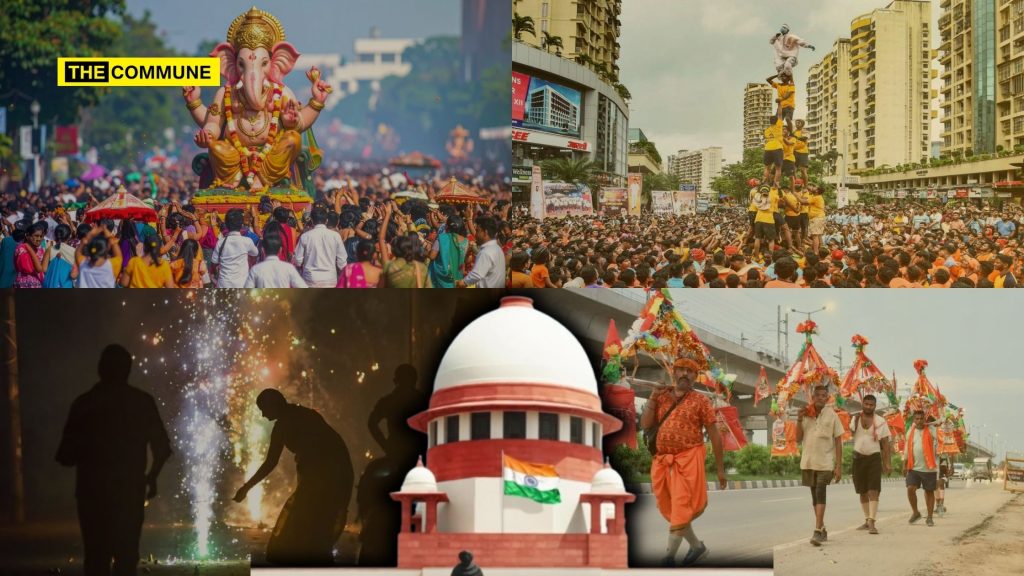
From 2021 to 2025, Indian courts have been petitioned repeatedly regarding the conduct of Hindu religious processions, balancing religious freedoms with concerns over public order, environment, and health. This report details 10 significant judicial interventions, highlighting a trend where the judiciary has often upheld the right to worship while imposing conditions, with a smaller number of rulings restricting processions primarily on public health and environmental grounds.
#1 Orissa HC Upholds Hanuman Jayanti Procession – 26 March 2025
The Orissa High Court dismissed a petition by seven Muslim men seeking restrictions on the Hanuman Jayanti procession in Sambalpur, citing fears of communal unrest based on a 2023 incident. The Division Bench of Chief Justice Harish Tandon and Justice Arindam Sinha refused to impose pre-emptive restrictions, noting the state’s assurance of adequate preventive measures. The court emphasized that mere apprehensions cannot justify judicial interference and highlighted the need to balance the right to life with religious freedoms, ultimately trusting the state’s machinery to maintain public order during the festival.
#2 Allahabad HC Rejects Loudspeaker Ban at Mahakumbh – 12 February 2025
The Allahabad High Court dismissed a Public Interest Litigation (PIL) seeking the removal of loudspeakers from the Mahakumbh Mela in Prayagraj. The petitioners, including Brahmachari Dayanand, claimed the noise disturbed their meditation. However, the bench of Chief Justice Arun Bhansali and Justice Kshitij Shailendra ruled that the petition lacked substantial evidence proving noise pollution exceeded permissible limits. The court stated that mere photographs and references to Supreme Court judgments were insufficient grounds for judicial intervention, allowing the use of loudspeakers to continue at the massive religious gathering.
#3 Odisha HC Mandates Noise Control for Durga Puja – 03 October 2024
The Odisha High Court issued strict directives to curb noise pollution during Durga Puja celebrations in Cuttack. A special bench comprising Justices Sangam Kumar Sahoo and V Narasingh emphasized that the right to celebrate should not come at the cost of public well-being, noting the adverse effects of loud noise on health, mental peace, and students’ studies. The court mandated that sound levels must not exceed 65 decibels and ordered the Deputy Commissioner of Police to file an affidavit detailing arrangements for noise control and traffic management, warning of strict action against violations.
#4 SC Stays Limit on Dhol-Tasha Troupes in Pune – 12 September 2024
The Supreme Court intervened in a cultural dispute, staying a National Green Tribunal (NGT) order that limited Dhol-Tasha-Zanj troupes to 30 members each during Pune’s Ganesh Visarjan. The bench, led by Chief Justice DY Chandrachud, emphasized the deep cultural significance of the Dhol-Tasha tradition in Pune’s festivities. While issuing notices to the Maharashtra government, the court granted relief to petitioners who argued the NGT’s restriction undermined a key element of the festival’s public celebration, prioritizing cultural expression amidst noise pollution concerns.
#5 Calcutta HC Permits Ram Navami Yatra in Howrah with Conditions – 16 April 2024
The Calcutta High Court permitted the Anjani Putra Sena and Vishwa Hindu Parishad to hold their traditional Ram Navami processions in Howrah. Justice Jay Sengupta allowed the rallies along their usual routes, rejecting the state government’s proposal for an alternative path citing previous communal violence. However, the court imposed strict conditions, limiting participants to 200 and directing that no provocative slogans be raised. The court also advised the state to seek Central Forces’ assistance to ensure law and order during the event.
#6 Calcutta HC Approves VHP’s ‘Shaurya Jagran Yatra’ – 04 October 2023
The Calcutta High Court granted conditional approval for the Vishwa Hindu Parishad (VHP) and Bajrang Dal to conduct their “Shaurya Jagran Yatra” in West Bengal. The rally, intended to honor freedom fighters and raise awareness of Hindu culture, had been denied permission by state police in certain districts. Justice Jaysen Gupta directed the petitioners to specify their route map and ordered the state government to maintain strict vigilance to ensure the procession proceeded peacefully, upholding the right to assemble while emphasizing regulatory oversight.
#7 Bombay HC Defers Plea for Ganpati Immersion in Aarey – 16 September 2023
The Bombay High Court declined to grant immediate relief to a Vishwa Hindu Parishad (VHP) plea seeking permission for Ganpati idol immersion in Mumbai’s Aarey Lake. The court deferred the hearing to September 25, after the festival, as the original bench was unavailable. The plea was filed after municipal authorities prohibited immersion in natural lakes citing environmental concerns from an ongoing petition. The VHP had argued for an exemption or the creation of artificial ponds, but the court prioritized the environmental case over the urgent religious accommodation.
#8 Calcutta HC Allows Ram Navami Yatra in Nabadwip – 30 March 2023
The Calcutta High Court permitted a Ram Navami Shobha Yatra in Nabadwip, directing police to provide necessary security. Justice Rajasekhar Mantha allowed the procession from Chatir Math to Gabtala after the petitioner, Saumen Kansabanik, assured compliance with all regulations, including noise pollution norms. The state government had opposed the plea, citing other ongoing religious functions in the area. The court balanced the competing interests by allowing the yatra while ensuring it would not disrupt other community events, upholding the right to religious procession.
#9 Karnataka HC Allows Datta Jayanti at Disputed Shrine – 30 November 2022
The Karnataka High Court permitted three-day Datta Jayanti celebrations at the disputed Datta Peetha shrine in Bababudangiri Hills. The bench of Justices Alok Aradhe and N Vishwajith Shetty allowed the celebrations under the supervision of a government-appointed committee. The shrine is at the center of a long-standing dispute between Hindu and Muslim groups. The court emphasized that new ritual measures would be subject to its final verdict on an ongoing appeal, allowing the festival while maintaining judicial oversight over the sensitive site.
#10 Orissa HC Allows Regulated Green Crackers for Diwali
01 November 2021
The Orissa High Court permitted the sale and use of certified “green crackers” during Diwali, but within a strict two-hour window from 8 PM to 10 PM. The bench of Chief Justice S. Muralidhar and Justice B.P. Routray ruled that only fireworks conforming to NEERI’s formulation and certified by the Petroleum and Explosives Safety Organisation (PESO) could be sold in designated zones. The court clarified that mere labeling with QR codes was insufficient, upholding the Supreme Court’s precedent of banning firecrackers containing harmful barium salts while allowing environmentally safer alternatives.
#11 Calcutta HC Imposes Total Diwali Firecracker Ban – 29 October 2021
The Calcutta High Court ordered a complete ban on the sale and use of all firecrackers, including green crackers, during Diwali and Kali Puja in West Bengal. The court mandated that the ban would remain in effect for all subsequent festivities that year. The ruling was driven by concerns over deteriorating air quality and the harmful effects of pollution on public health and the environment. The blanket prohibition was one of the most stringent judicial measures taken to curb air pollution during a major Hindu festival.
#12 Telangana HC Upholds Ban on PoP Idol Immersion – 13 September 2021
The Telangana High Court refused to modify its ban on the immersion of Plaster of Paris (PoP) Ganesh idols in Hyderabad’s Hussain Sagar and other lakes. The bench, led by Chief Justice M Ramachandra Rao, stated it could not pass any order that permits water pollution, even temporarily. It noted that the government had ample time since the previous year to create alternative immersion facilities but had failed to take adequate steps. The court’s firm stance reinforced the environmental rationale behind restricting religious practices that cause ecological harm.
#12 SC Intervention Leads to UP Cancelling Kanwar Yatra – 18 July 2021
The Supreme Court stressed that the Right to Life under Article 21 is paramount and asked the Uttar Pradesh government to reconsider allowing a “symbolic” Kanwar Yatra amid the Covid-19 pandemic. The bench of Justices R F Nariman and B R Gavai took suo motu cognizance of the issue. Following this judicial nudge, the UP government subsequently announced the complete cancellation of the annual pilgrimage after discussions with Kanwar Sanghs, prioritizing public health and safety over religious sentiments during a critical phase of the pandemic.
#13 Bombay HC Bans PoP Idols for Maghi Ganpati – 18 July 2021
The Bombay High Court issued an interim order prohibiting the production, sale, and immersion of Plaster of Paris (PoP) idols ahead of the Maghi Ganpati festival. The bench of Chief Justice Alok Aradhe and Justice Bharti Dangre directed strict enforcement of Central Pollution Control Board guidelines to prevent environmental damage. The ruling acknowledged the livelihood concerns of artisans but prioritized ecological protection, sparking a debate between environmental conservation and the economic impact on those dependent on the idol-making industry.
#14 Punjab & Haryana HC Limits Diwali Firecracker Timing – 13 October 2017
The Punjab and Haryana High Court restricted the bursting of firecrackers on Diwali to a strict three-hour window from 6:30 PM to 9:30 PM. The bench of Justices Ajay Kumar Mittal and Amit Rawal also prohibited firecracker use before and after the festival and limited the number of temporary licences issued. The court, acting on air quality concerns, declared previously granted licences inoperative and mandated monitoring by authorities and NGOs to ensure enforcement, highlighting the judicial role in managing seasonal pollution.
#15 Supreme Court Restricts Dahi Handi Ritual for Safety – 17 August 2016
The Supreme Court barred children below 18 from participating in the Dahi Handi ritual and upheld a 20-foot height limit for human pyramids. The ruling came in response to a clarification plea by the Maharashtra government and a contempt petition alleging non-compliance with a 2014 Bombay High Court order. The apex court stated that allowing minors in such dangerous stunts was against public interest, prioritizing participant safety. The bench remarked that while Lord Krishna stole butter, he never performed hazardous stunts for it.
#16 Bombay HC Orders Strict Noise Pollution Enforcement – 09 October 2015
The Bombay High Court directed all civic and government authorities in Maharashtra to take strict action against organizations violating noise pollution norms during festivals like Dahi Handi, Ganesh Chaturthi, and Navratri. The bench of Justice Abhay Oka and Justice V.L. Achilya warned that officers failing to act could face contempt of court. The order came from PILs highlighting that noise rules were widely flouted during recent festivals and that authorities had failed to take adequate action, leading to public disturbance.
#17 Allahabad HC Bans Idol Immersion in Rivers – 07 October 2013
The Allahabad High Court ordered a complete ban on idol immersion in the Ganga and Yamuna rivers across Uttar Pradesh. The bench of Justice Ashok Bhushan and Justice Arun Tandon rejected the state government’s plea for managed immersions, directing that the state’s rivers be freed from this activity within a year. The order was issued during the hearing of a petition raising concerns about river pollution and condition, reinforcing the judiciary’s role in enforcing environmental protection over traditional religious practices.
Subscribe to our channels on Telegram, WhatsApp, and Instagram and get the best stories of the day delivered to you personally.