


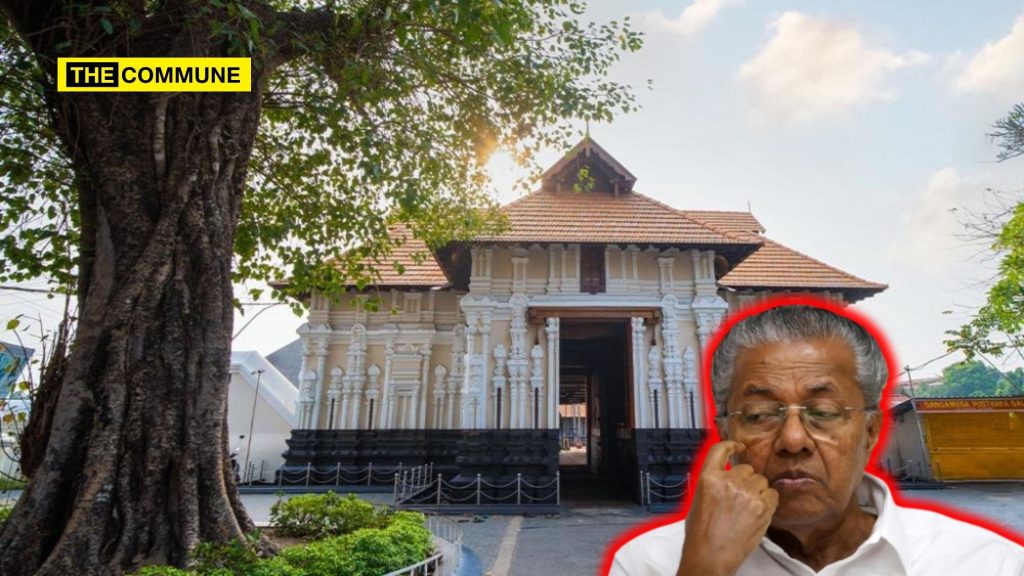
Kerala has been in the news lately for quite a few things – be it the Global Ayyappa Summit or the missing gold sheets that were taken from the Sabarimala temple without permission to Chennai.
In this report, we will take a look at 14 major incidents from 2019 to 2025 which shows persistent and systematic interference by the Kerala government in the administration and traditions of Hindu temples across the state. Despite repeated demands from devotees and Hindu groups for greater autonomy, the government has defended its control, claiming it is necessary for temple revival.
#1 CM Pinarayi Vijayan Rejects Devotee Administration Handover
In September 2025, at the Global Ayyappa Summit in Pamba, Chief Minister Pinarayi Vijayan firmly rejected demands to return temple administration to devotees. Defending the current system, he stated that government control via the Devaswom Boards was essential for reviving temples. This stance was seen by critics as a direct dismissal of long-standing calls from the Hindu community for autonomy, reinforcing the perception that temples are kept under political control for non-religious purposes.
#2 Sabarimala Gold Scandal Probe Stalled
In September 2025, the Travancore Devaswom Board faced fresh outrage over allegations of missing temple gold. Ornaments sent for remodelling in 2022 were reportedly returned lighter, with claims that up to 90 kg of gold was unaccounted for. Critics allege that the Crime Branch investigation, under the Chief Minister’s purview, has been deliberately stalled, pointing to a potential political cover-up. Devotees accused the CPI(M)-controlled board of misusing Sabarimala’s substantial annual income and turning faith into a business.
#3 Communist Govt Conducts ‘Global Ayyappa Sangamam’, Draws Flak
In September 2025, the CPI(M)-led government organized a ₹4 crore Global Ayyappa Sangamam event through the Devaswom Board. While projected as a global pilgrimage meet, opposition parties labelled it an election gimmick to regain Hindu voter support after the contentious 2018 Sabarimala issue. The event was boycotted by the Pandalam royal family, with critics asserting that the government was once again using faith as a political tool rather than focusing on genuine devotional aspects.
#4 Accusations of Commercializing Ayyappa Sangam
Again, in September 2025, the Bharatheeya Vichara Kendram strongly criticized the Kerala government for allegedly using the Ayyappa Sangam event for political and commercial gains instead of fostering devotion. The group accused the state of mismanaging Sabarimala affairs, lacking transparency in temple finances, and interfering in religious traditions. They warned that such actions were undermining the sanctity of the holy site, transforming it into a commercial hub for non-devotional purposes.
#5 Ban on Political Flags in Temple Premises
In September 2025, the Kerala government’s Devaswom Department issued an order prohibiting political flags, pictures, and publicity materials inside all temple compounds under its control. While presented as a regulatory measure, the move was interpreted by many as direct government intrusion into temple management. Critics argued that it reinforced state control over sacred spaces, limiting the expression of devotees and traditional practices associated with temple festivals.
#6 Devotee Backlash Over Global Ayyappa Event
In September 2025, the government’s plan to host a “Global Ayyappa Sangamam” was met with significant criticism from devotees and Hindu groups, who perceived it as political interference. In protest, the Sabarimala Karma Samithi announced a parallel “Sabarimala Samrakshana Sangamam” in Pandalam to defend the temple’s customs. This opposition highlighted a deep-seated mistrust, with devotees arguing that the state was dividing worshippers and undermining the temple’s spiritual autonomy for political spectacle.
#7 Push to Open Padmanabhaswamy Temple Vault-B
In August 2025, during a governing body meeting for the Sree Padmanabhaswamy Temple, the Kerala government’s representative pressed for a decision to open the sacred Vault-B. This move was opposed by the Travancore royal family and the temple’s tantri (head priest), who consider the vault inviolable. Devotees saw the government’s push as a severe disregard for centuries-old traditions and the sentiments of millions, representing unwarranted state interference in one of India’s most revered temples.
#8 CPI(M) Party Songs Played at Temple Festival
In March 2025, a controversy erupted at the Kadakkal Devi Temple in Kollam when songs associated with the CPI(M)’s youth wing, DYFI, were played during a musical program at the Thiruvathira festival. The presence of party symbols sparked accusations of politicizing a religious event. While the festival committee claimed the songs were audience requests, the Travancore Devaswom Board sought a report, and opposition leaders condemned the incident as an “arrogant misuse of power.”
#9 Restrictions on Sabarimala Pilgrim Numbers
In October 2024, the Kerala government’s decision to limit daily pilgrim entry to Sabarimala to 80,000 and mandate an online queue system triggered widespread protests. Devotees argued that these restrictions unfairly impacted those traveling long distances and represented excessive government control over temple access. The move was perceived as unnecessary interference that disrupted the traditional practice of free darshan (holy viewing), further straining the relationship between the administration and the worshipping community.
#10 Police Demand Removal of Saffron Buntings
In February 2023, at the Vellayani Bhadrakali Temple in Thiruvananthapuram, Kerala Police officials ordered the temple committee to remove traditional saffron buntings ahead of the triennial Kaliyootu Mahotsavam, citing vague law-and-order concerns. The verbal demand, made without a written order, was met with resistance from devotees who viewed it as an assault on their age-old customs. The incident was seen as another example of authorities harassing temples and interfering in their religious expressions.
#11 Forcible Takeover of Mattannur Temple
In October 2021, the CPI(M)-controlled Malabar Devaswom Board forcibly took over the Mattannur Mahadeva Temple in Kannur amidst protests, including attempts at self-immolation by devotees. Officials broke the temple lock, citing a court order that deemed the temple government property. The Board President’s statement that temples are “public” while churches and mosques are “private” sparked accusations of discriminatory treatment of Hindu religious institutions, with many labelling the takeover as politically motivated interference.
#12 Court Rules Temple Donation to CMDRF Illegal
In December 2020, the Kerala High Court struck down the Guruvayur Devaswom Committee’s decision to divert ₹5 crore from temple funds to the Chief Minister’s Distress Relief Fund (CMDRF). The court ruled that the temple’s wealth belongs solely to the deity and cannot be used for government purposes. The judgment was a significant indictment of the state’s attempts to misuse temple funds, highlighting a pattern of diverting religious donations for secular government projects.
#13 Widespread Allegations of Corruption in Devaswoms
In November 2019, a report highlighted allegations of systemic corruption, political misuse, and mismanagement against the Devaswom Boards that control over 3,000 temples in Kerala. Accusations included financial theft, sex scandals, and the appointment of non-Hindus to management roles. Critics argued that temple funds were being diverted to non-religious projects, sidelining devotees and priests, and causing lasting damage to the sanctity and financial health of these institutions under political control.
#14 Government’s Firm Stance on Sabarimala Entry
In August 2019, Chief Minister Pinarayi Vijayan reaffirmed his government’s commitment to enforcing the Supreme Court’s order allowing women of all ages to enter the Sabarimala temple, despite massive protests. The LDF government’s stance was widely perceived as insensitive interference in core temple traditions, leading to widespread unrest. The incident became a major political flashpoint and was cited as a key factor in the ruling party’s poor performance in the subsequent parliamentary elections.
Subscribe to our channels on Telegram, WhatsApp, and Instagram and get the best stories of the day delivered to you personally.