The News Minute has been the face of leftist narrative peddling for quite some time. A while ago, they came up with an “explainer” series and put a woman as the face of it – to possibly counter the “misogynistic” mansplaining with Pooja Prasanna’s “Let Me Explain” (LME) series. There was another lady before her. Over approximately two years, they have built a playlist of 100 episodes (2023-2025) and claim to ‘break down complex issues’. Its official positioning promises to “cut through the media noise,” “keep it factual without raising the volume,” and “declutter” complex topics to start “important conversations.”
However, a close look at the entire series very quickly reveals what the series is all about. Far from being a neutral explanatory guide, “Let Me Explain” operates as a sophisticated vehicle for narrative setting/engineering, systematically advancing a woke radical leftist, anti-Hindu, sub-nationalist agenda.
In this article, we try to break down the tricks and themes that shape Let Me Explain.
I. The Thematic Architecture: A Quantitative Breakdown Of 100 Episodes
When you go through all the 100 episodes, a clear pattern is revealed.
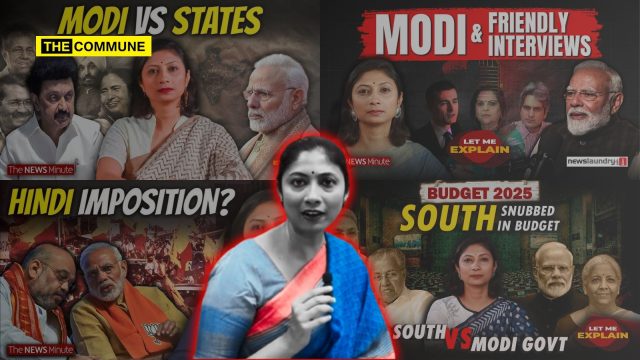
Anti-Modi Narrative (35% – 35+ Episodes): This is the series’ central pillar. Episodes like “How India hid its COVID-19 death numbers | Modi,” “Why Modi won’t face the press & why it matters,” and “Amit Shah and his false data on Electoral Bonds” consistently frame the ruling government as authoritarian, deceptive, anti-democratic, and communal. The pattern is unrelenting: the Modi government is the primary antagonist in the LME narrative universe.
South vs. North Narrative (15% – 15+ Episodes): The series meticulously cultivates a victimhood narrative to feed Dravidianist separatism in Tamil Nadu. Episodes such as “Why south Indian states have started a tax movement,” “Stalin vs Modi: Union govt denying funds to best-performing states?” and “Tamil Nadu’s century long fight against Hindi imposition” position the Centre as a discriminatory force, with a special focus on favouritism towards Gujarat and the imposition of Hindi.
Democracy In Danger Narrative (12% – 12+ Episodes): LME systematically questions the integrity of India’s democratic processes. “Vote chori’: Inside India’s voter list scandals,” “Why Election Commission is called biased,” and multiple episodes on Electoral Bonds portray the BJP as the beneficiary of rigged systems and institutional capture, undermining electoral legitimacy. What it basically does is act as Congress’ mouthpiece, to create a democratic deficit by sowing distrust about the election process.
Hindutva Or Political Hinduism As Threat (12% – 12+ Episodes): Hindu nationalism is uniformly framed as a dangerous social poison. From “Beef politics: Rise of cow vigilantes” and “The Truth Behind ‘Love Jihad’: Exposing Myths” to “Ladakh’s fight for jobs, land and against Hindutva,” the series dismisses or pathologizes Hindu concerns while framing religious mobilization solely as a cynical BJP electoral strategy.
On the other hand, political Islam is given a pass.
Pro-Naxal Narratives (8% – 8 Episodes): This category serves as the social justice pillar, advocating for a caste census, framing activists like GN Saibaba as dissent martyrs, and portraying the UAPA as a draconian tool of state oppression. Figures like musician TM Krishna are celebrated as heroes.
Peddling Adani/Ambani Trope (8% – 8+ Episodes): The “Adani Trilogy” and episodes on wealth inequality construct a narrative of a corrupt corporate-government nexus. The Ambani wedding extravaganza is contrasted with the struggles of the middle class, advocating for wealth redistribution and state intervention.
Systemic Failures (10% – 10 Episodes): The remaining episodes on police encounters, stampedes, and exam failures are framed not as isolated tragedies but as evidence of systemic collapse and an accountability deficit under the current regime.
This breakdown makes the larger picture clear – the pattern is pretty hard to ignore. “Let Me Explain” is not a general interest explainer but a targeted ideological project.
II. The Narrative Engineering Toolkit: Techniques Of Persuasion And Bias
LME’s punch lies not just in what it covers, but how it frames its content. The series employs a repeatable set of propaganda setting techniques.
Title Construction: Pre-Judging The Conclusion
The bias is revealed right in the titles with their loaded language. They are designed to trigger an emotional response and pre-empt critical thinking.
Accusatory Language: “How India hid its COVID-19 death numbers,” “How CBFC is butchering movies,” “Electoral Bonds scheme or scam?”
Villain Identification: Direct naming of Modi, Amit Shah, Adani, and the RSS ensures the audience knows who to blame before the video even begins.
Victimhood Centering: “Why southern states are upset,” “Demonising dissent,” “Forced to bury bodies.”
Rhetorical Questions: “Why Modi won’t face the press & why it matters” frames a political choice as an inherent democratic crisis.
The Episode Structure: An Eight-Step Formula For Outrage
Across diverse topics, LME follows a precise, repeatable structure that transforms complex issues into emotionally charged narratives:
The Hook: A positive acknowledgment is immediately undermined by an ominous “but,” transforming a sacred pilgrimage site or a government scheme into a subject of suspicion within seconds.
Historical Pattern: Unconnected past incidents are presented as a deliberate pattern, establishing a narrative of victimhood or conspiracy without statistical context.
Present “Crisis”: A current allegation or data point is framed as the latest evidence of this pattern, with testimony elevated to fact and previous episodes cross-referenced to create an illusion of mounting proof.
Selective Data Dump: Raw numbers are presented for shock value (e.g., “Gujarat gets more funds than all southern states combined”) while omitting crucial context like per capita calculations or infrastructure requirements.
Emotional Manipulation: Hypothetical scenarios (“Imagine being a family member…”) and personal anecdotes bypass rational analysis, ensuring the viewer identifies with the framed victim.
Systematic Indictment: The issue is escalated from a specific case to a broad indictment of the system using rhetorical questions that shift the burden of proof onto the accused.
The Subscription Appeal: A funding request is embedded within the moral outrage, positioning subscription as a duty to support “truth-telling” against powerful interests.
Case Study: The Dharmasthala Episodes – How Speculation Was Labelled As Investigation
Episodes 82 and 85 on Dharmasthala exemplify the series’ most problematic tendencies. Using titles like “‘Forced to bury bodies’: Allegations by a sanitation worker” and “A history of deaths that haunt Dharmasthala,” LME employs:
Loaded Language: Emotionally charged words that imply guilt.
Privileging Allegation: Elevating unverified worker testimony to the level of fact.
Burden Shifting: Implying the institution must disprove the claims rather than the series proving them.
This technique launders conspiracy theories as investigative journalism, destroying reputations based on speculation.
III. The Ideological Universe Of LME: Villains, Heroes, and Worldview
The series paints everyone in black and white – only heroes and villans exist.
The Villain Roster:
Primary: Narendra Modi, the BJP, the RSS, and Amit Shah – portrayed as an authoritarian, communal, and corrupt nexus.
Secondary: Adani/Ambani (crony capitalists), the Election Commission and SEBI (compromised institutions), Gujarat (favouritism beneficiary).
Rotating: Yogi Adityanath, Narayana Murthy, and institutions like the CBFC and NCERT.
The Hero Framework:
Celebrated Figures: Opposition leaders (Stalin, Siddaramaiah), activists (GN Saibaba, Rohith Vemula), artists (Pa. Ranjith, TM Krishna), and basically anybody with a woke radical worldview.
The Pattern: Heroes are exclusively those who challenge not every established power but only the BJP, RSS is a threat whereas PFI, SDPI, Muslim League, Jamaat are democratic forces, represent aggressive proselytizing voices as the victims while ignoring the plight of Hindu voices.
The Core Ideology Peddled By The Series
Politically: The BJP is painted as an authoritarian monster dismantling democracy, while the entire opposition is portrayed as a helpless victim. Even figures like Umar Khalid and Sharjeel Imam—who openly incited unrest during the Delhi riots as part of a coordinated regime-change mobilisation—are projected as martyrs. Yet when the DMK government goes after critics in Tamil Nadu, or when someone like Ketaki Chitale is jailed simply for a social media post, the national outrage suddenly disappears.
Economically: Corporate wealth is illegitimate cronyism; welfare spending (“revdi”) is an unalloyed good.
Socially: Hindutva is an existential threat; enforcing caste identity and linguistic politics, leaving Hinduism are the primary vehicles for liberation.
Regionally: Indian Nationalism is bad, regionalism is good. South India is a victim of Northern exploitation; regional parties no matter how corrupt they’re protect the Constitution.
Opinions Laundered As Explanation
After taking a look at the 100 episodes, the conclusion is pretty straightforward.
“Let Me Explain” doesn’t explain, it indoctrinates.
Its primary function is not to educate but to indoctrinate; not to declutter but to inflame; not to inform but to reinforce. It is a storytelling machine to push one narrative:
- Systematically demonizes one political party/group while romanticizing its opponents.
- Cherry-picks data and manipulates language to pre-determine conclusions.
- Exploits its subscription model to monetize audience outrage and confirmation bias.
- Erodes nuance, critical thinking, and the possibility of political compromise by reducing India’s complex reality to a simplistic battle between good and evil.
The subscription-driven funding model of Let Me Explain incentivizes ideological reinforcement over journalism. Because subscribers pay to have their worldview affirmed, the series avoids heterodox views and relies on outrage, crisis framing, and constant villainization of the BJP to retain its base. Balanced reporting risks cancellations, so emotional, partisan narratives become the product. This creates a loyal “TNM community” – kind of like a radical woke leftist cult in which criticism feels personal. The result is money starts steering the coverage, not facts.
Criticizing the government is fine, we live in a democracy; it’s the way it pretends to be neutral while twisting facts. It disguises advocacy as neutrality and speculation as investigation. It creates an audience that is politically engaged yet poorly informed, armed with talking points yet incapable of understanding opposing arguments.
Subscribe to our channels on WhatsApp, Telegram, Instagram and YouTube to get the best stories of the day delivered to you personally.