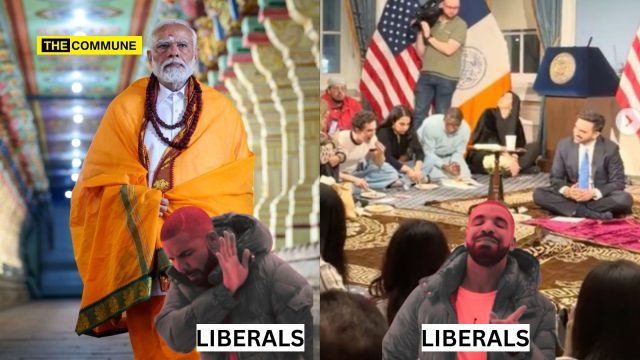
On 11 March 2026, New York City Mayor Zohran Mamdani hosted an official Ramadan iftar inside New York City Hall, described by his own team as welcoming Ramadan into “the people’s house”. The event was covered warmly by Western media, celebrated on social platforms, and framed as historic, inclusive, and progressive.
View this post on Instagram
No outrage. No op-eds about the separation of church and state. No articles about religion being “weaponised” inside a government building.
That standard is reserved exclusively for Narendra Modi.
What Mamdani Did – In a Government Building
Mamdani did not merely observe Ramadan privately. He converted New York City Hall, a government institution, into a venue for an official religious ceremony, hosted on behalf of his faith. His senior aide confirmed he planned multiple iftar dinners with firefighters, delivery workers, and Muslim communities – all using City Hall and his mayoral platform. He publicly stated: “Ramadan is my favourite month of the year,” and fasted while conducting official government duties.
By any definition applied to Modi, this is a head of government using public office to publicly practice and promote religion.
What They Said About Modi
When PM Modi presided over the Ram Temple consecration in Ayodhya on January 22, 2024, India’s liberal commentariat, the same voices who applaud Mamdani, had their knives out.
Rana Ayyub told TIME Magazine: “His entire career has been based on Ayodhya because he realized early on that the only way to become a favourite of the masses is to endear them through the Ram Temple movement. This is the ultimate moment of Modi as a Hindu nationalist leader, and this is the ultimate moment of creating the Indian Muslim as a second-class citizen.” Rana Ayyub further described the Ram Temple as an act of deliberate communal aggression, “rubbing salt into an already existing wound” and framed Hindu celebration of the consecration as an ‘act of Muslim erasure’.
Arfa Khanum Sherwani of The Wire and Zohran Mamdani’s biggest cheerleader has repeatedly framed Modi’s public religious practice, from the Ram Temple groundbreaking to Ganga puja ceremonies, as “Hindu nationalist consolidation” and electoral mobilisation, rather than a PM practising his faith.
The pattern is consistent: a Hindu PM being a Hindu, practicing Hinduism, consecrating India’s most sacred temple = communalism, nationalism, Muslim oppression. A Muslim mayor hosting a religious ceremony in a government building in New York = historic, beautiful, inclusive. The same three names have not published a syllable of scrutiny about Zohran Mamdani and City Hall.
The Indian National Congress officially framed the Pran Pratishtha as a “political drama” – a characterisation that later prompted Ayodhya seers to demand Rahul Gandhi be barred from entering the Ram Temple.
Hindus for Human Rights called it “weaponizing faith” and an “electoral stunt”. The Conversation wrote that Modi “exploits religious differences” and uses religion for political purposes. The Cato Institute framed Modi’s religious conduct as an assault on minority freedoms. East Asia Forum warned that Modi’s “Hindu agenda” was “damaging” to democracy.
Not one of these voices has published a comparable critique of Mamdani hosting a religious ceremony inside City Hall using his office as mayor.
Be it in India or abroad, they all sang the same tune when it came to PM Modi.
The Selective Secularism Argument
The critics who attacked Modi were not defending secularism. They were selectively applying it. Secularism, if applied consistently, would require the same scrutiny of a Muslim mayor hosting religious dinners inside City Hall as it does of a Hindu PM consecrating a temple. The praise or silence on Mamdani is not a revealed preference: religion in public office is fine, as long as it is not Hinduism.
This is not a new pattern. Western academia, activist groups, and media have spent a decade producing a steady pipeline of anti-Modi, anti-Hindu content while treating equivalent or greater expressions of Islamic identity in Western public office as celebrations of diversity.
The Bottom Line
Zohran Mamdani can fast, host iftars, practice his faith and be celebrated for it. That is his right and if he does that as a democractically elected leader and praised for it, the same courtesy must be extended to a Hindu prime minister in a Hindu-majority nation; it doesn’t become authoritarianism, communalism, or a threat to democracy.
Subscribe to our channels on WhatsApp, Telegram, Instagram and YouTube to get the best stories of the day delivered to you personally.