


It seems the modern Hindu has failed, once again, to grasp the fundamental rules of global citizenship. We have not yet learned that our faith is a private neurosis, to be practiced in whispers, not a civilization to be celebrated in the open. Our recent, unfortunate visibility has drawn the ire of the global liberal priesthood, and their verdict is in: we are too loud, too colorful, and far too unapologetic.
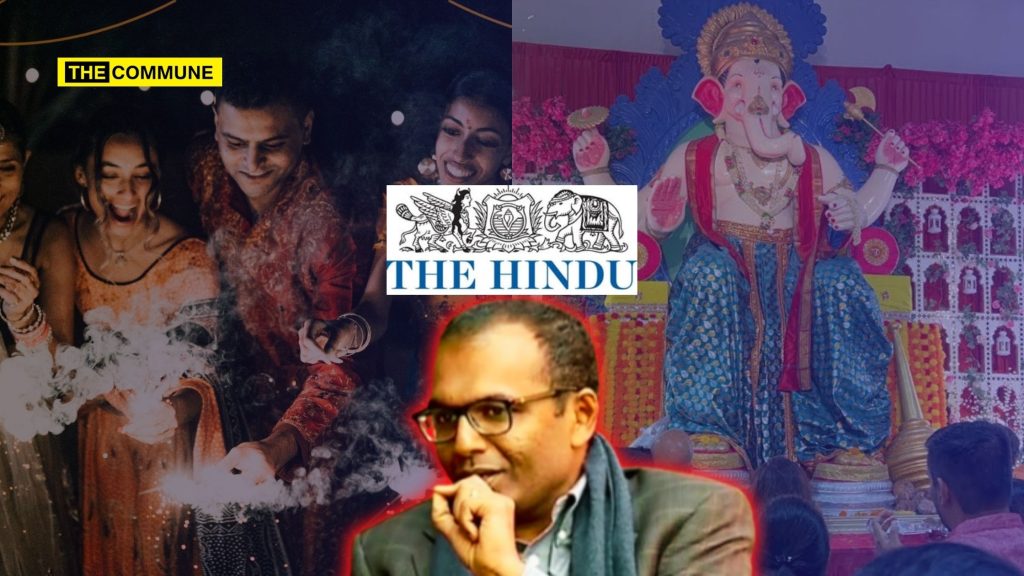
In his latest sermon disguised as an analysis in The Hindu, from the pulpit of post-colonial guilt, Varghese K George has served as a timely reminder of our place. The charges are clear: the immersion of a Ganapati idol in a foreign river is “pollution,” while the same act by a local municipality is “tradition.” The bursting of a firecracker on Deepavali is “cultural exhibitionism,” while the sonic bombardment that rings in every New Year from Sydney to London is “celebration.” The logic is impeccable, if you are blessed with the right kind of eyes – eyes that see a problem only when the skin is brown and the gods are many.
But the most insidious part of this new doctrine is the intellectual sleight of hand that equates festival fervor with “state-sponsored” subversion. According to this gospel, a Hindu celebrating Deepavali is not merely celebrating; he is an “active member of Indian strategy,” a foot soldier in a “cultural nationalist” project. Yet, when George or any other commentator celebrates Easter or Christmas, it is never framed as part of a “Christian nationalist plan to destabilize the country.” No, their faith is personal; ours is political. Their celebrations are benign; ours are a “malign” influence.
There is a palpable nostalgia in these circles for the “good Indian” – the Nehruvian model who knew his place was to be a silent, grateful guest in someone else’s story. This ideal immigrant sent remittances home but left his culture at the border; he contributed to the economy but never to the cultural conversation. He was the perfect subject for a Western fantasy: industrious, docile, and invisible. Today’s Hindu, however, commits the unforgivable sin of existing in the present tense – vibrant, vocal, and visibly different. How dare we?
The great comedy of our time is watching the West, which has built a secular religion out of celebrating every conceivable identity, suddenly develop a case of the vapors when faced with the unassimilated Hindu. Pride parades that take over city centers for weeks are a triumph of diversity. Mardi Gras that transforms entire cities into bacchanals is cherished cultural heritage. But a Hindu procession with drums and deities? That, we are told, is a threat to social harmony. The rainbow flag can fly proudly over town halls, but the bhagwa dhwaj is a provocation. It appears the grand project of multiculturalism has a secret clause: Thou shalt not be proudly, publicly Hindu.
And where, pray tell, is the statistical evidence that our celebrations cause more law and order problems per capita than any other community’s? There is none. We are judged not by data, but by anecdote and the visceral discomfort we provoke. A single firecracker incident in Edmonton becomes a symbol of our “uncivilized” nature, while annual riots after sporting events are written off as “passionate fandom.”
Beneath this anxiety lies a deeper, more visceral fear: the loss of control. For centuries, the non-white world was expected to be the audience to the West’s spectacle. We were the consumers of their culture, the converts to their faith, the subjects of their study. The Hindu who refuses to play this role, who instead declares, “My civilization is ancient, my philosophy is profound, and I will not be ashamed”, is the ultimate disruptor. He cannot be easily categorized as a victim, nor can he be dismissed as a primitive. He is, simply, inconvenient.
The prescription for this disease of pride is simple. We must learn to sanitize our faith for foreign consumption. Our Deepavali must become a “festival of lights” stripped of its spiritual meaning, a quaint ethnic event. Our rituals must be repackaged as “wellness” and “mindfulness.” Our gods must be aestheticized as art, never acknowledged as living deities. We must become brown-skinned vessels for white, secular values – the perfect global citizens, empty of any real cultural baggage.
So, let us be forewarned. The sound they cannot stand is not the crackle of a firework or the beat of a dhol. It is the sound of a billion people, after centuries of silence, finally finding their voice. It is the sound of a civilization, not in decline, but in glorious, noisy renaissance. And no amount of hand-wringing from the commentariat can drown it out.
Subscribe to our channels on WhatsApp, Telegram, Instagram and YouTube to get the best stories of the day delivered to you personally.